Rivet Nut Gun M5 M6 M8 M10 Kit: What's Inside and What Bulk Buyers Overlook
Rivet Nut Gun M5 M6 M8 M10 Kit: What's Inside and What Bulk Buyers Overlook
If you've sourced hand tools from a Chinese factory before, you already know the spec sheet isn't the whole story. A "rivet nut gun kit" can be five parts or thirty, and the difference usually shows up later — at the receiving dock, on the assembly line, or in a customer support email six months after delivery.
This page walks through what a proper M5–M10 hand rivet nut gun kit actually contains, where factories quietly cut corners, and the three or four checks that save you a round of emails before you commit to a bulk order.
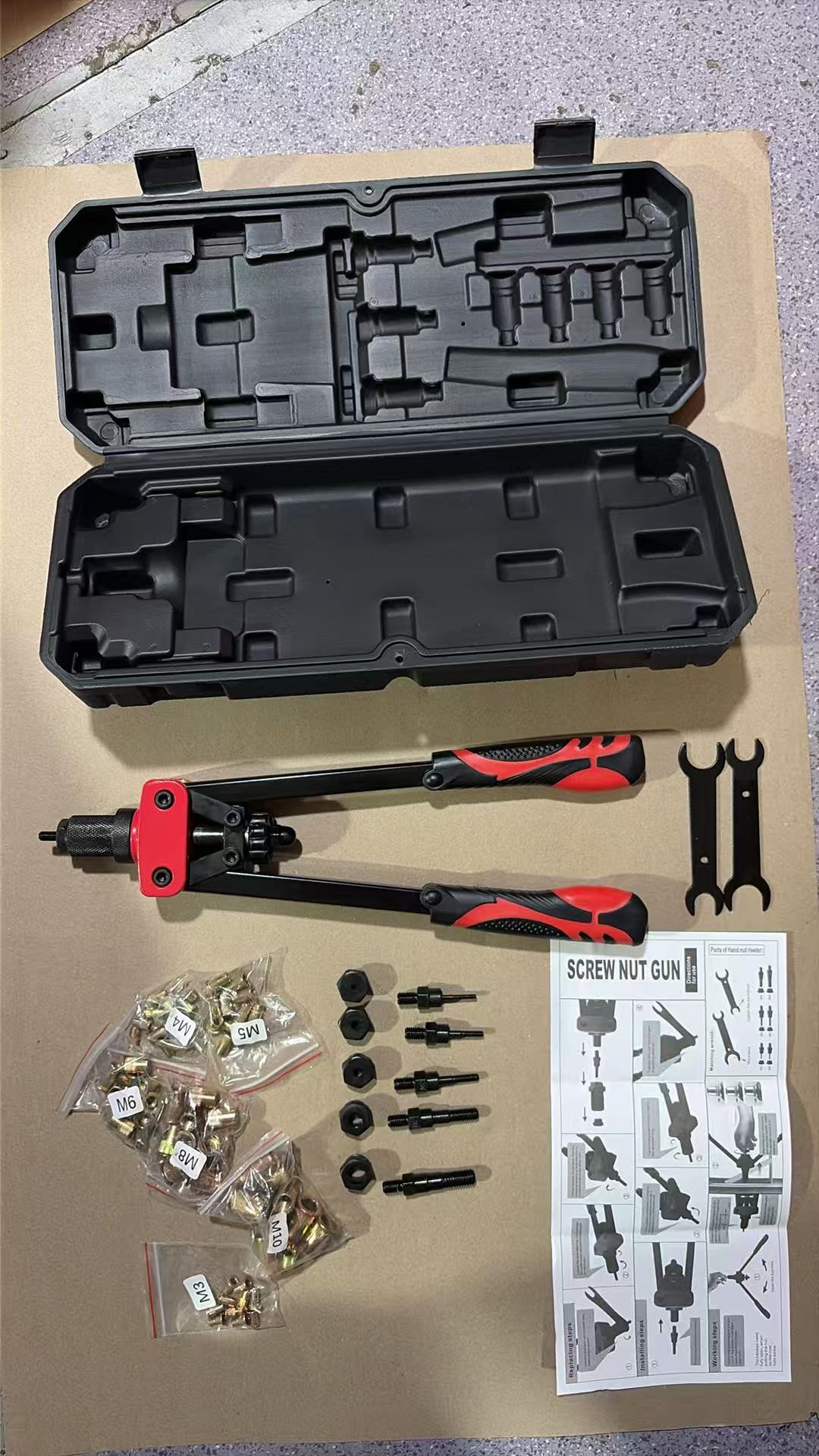
The kit above: hand rivet nut gun, blow-molded case, five mandrels (M5/M6/M8/M10), starter pack of rivet nuts, swap wrench, printed manual. Standard configuration for export.
The gun itself (the part everyone looks at first)
A hand rivet nut gun is mechanically simple — a long lever arm, a threaded nose, and a set of mandrels that thread in and out. What separates a workable one from a frustrating one usually comes down to three things:
- Lever ratio. A longer arm gives you more mechanical advantage, which matters when you're setting M8 or M10 rivet nuts into 1.5–2.0 mm sheet metal. A short arm on a big rivet nut is a wrist injury waiting to happen.
- Handle grip. If your end user is on an assembly line, the grip is what they feel all day. Hard plastic saves you fifty cents per kit; TPR or rubber overmold saves the buyer's palm.
- Mandrel thread standard. M5, M6, M8, M10 cover roughly 80% of sheet-metal riveting work. Make sure the gun you order actually accepts all four — not just two with the rest as "optional accessories" that quietly add 30% to the unit cost.
Browse the broader hand rivet nut tools category for the single-tool versions and our related fasteners & riveting tools line.
The mandrels (the part that quietly costs you the most)
A mandrel is the small threaded shaft that pulls through the rivet nut to set it. They wear out. They bend. They get lost in the back of a service van. Most factories quote the gun price and treat the mandrels as an afterthought. That's where the post-sale complaints start.
Three things to check before you confirm the PO:
- How many mandrels are in the kit? Four (one per size) is the minimum. A kit with five or six gives your buyer spares for the sizes they actually use most — usually M6 and M8, in our experience.
- Are replacement mandrels sold separately? They should be. If the factory doesn't list them as a separate SKU, your buyer is replacing the entire gun when one mandrel fails. That's a warranty claim you didn't budget for.
- Heat treatment on the mandrel shafts. Cheap mandrels bend on the third M10 install. Hardened ones go for hundreds of cycles before you see deformation. You won't see this on a spec sheet — you see it six months in, when a competitor's mandrel is still working and yours isn't.
The kit in the photo ships with five mandrels covering M5, M6, M8, and M10. Most buyers add a spare M6 mandrel to the order — it's the size that gets used twice as much as the others in automotive and enclosure work.
The rivet nuts themselves
Some kits include a starter pack of rivet nuts. Some don't. Both are fine — but flag it on the PO so the buyer doesn't open the case expecting consumables and find a foam insert full of nothing.
If the kit does include them, here's what to verify:
- Material. Steel is the default. Stainless (A2 for general use, A4 for marine or chemical environments) costs more but matters when the end use is outdoor or corrosive. Aluminum is for soft applications only — don't let a factory substitute aluminum for steel to save cost without telling you.
- Finish. Zinc-plated is the baseline. Black oxide, nickel, and Dacromet show up in spec sheets — match the finish to the end use, not to the buyer's preference. White zinc for indoor, yellow zinc for slightly better corrosion resistance, Dacromet for harsh environments.
- Head style. Flat head, countersunk (CSK), or reduced head. The kit in the photo uses flat head across all four sizes, which is the most common configuration for general sheet-metal work. CSK adds cost and is only needed for flush-mounted applications.
The case and the small stuff
This is where a lot of factories quietly save money. The case is the first thing your buyer opens when the carton lands on their dock. If it's a thin vacuum-formed shell that cracks in three months, the whole kit feels cheap — even if the gun inside is solid.
- Case material. ABS plastic with a hinge is the baseline. Blow-molded cases (like the one in the photo) survive a transcontinental truck ride and a few drops off a workbench. They cost more but they pay for themselves the first time a kit goes back for warranty.
- Foam insert. Pre-cut foam holds each piece in place. Loose foam — or no foam — means rattling in transit, which means scratched mandrels, which means a buyer who thinks the kit is junk before they've even used it.
- Small parts. The kit above includes a small open-end wrench for swapping mandrels and a printed instruction manual. Both are tiny costs that prevent large support tickets.
The manual (yes, really)
A printed instruction sheet is often the difference between a one-star and a five-star review. Your buyer isn't always a rivet nut expert — sometimes they're a procurement manager who needs to demo the kit to their own customer next week. A clear, illustrated manual (the one in the photo uses real photos, not line drawings) lets them do that without picking up the phone.
If you're private-labeling this kit under your own brand, the manual is also the cheapest place to put your logo and a support email or QR code. Skip it and you've left the unboxing feeling generic, even if the case and the gun both carry your branding.
What bulk buyers actually ask before placing the order
A handful of questions come up on almost every wholesale inquiry for a kit like this. Worth having the answers ready on your product page or your first email reply:
- MOQ. 200–500 kits for the standard configuration (the kit in the photo). Lower for spot orders with stock colors, higher for full custom branding on the case and the gun.
- Lead time. 25–35 days for the standard kit from PO to FOB Ningbo. Add 7–10 days for custom handle color, custom case printing, or branded manuals in a non-English language.
- Customization. Handle color (red/black is the photo's combo; most factories offer three to five stock colors), case shell color, manual language (English, Spanish, French, German, and Italian are common export languages), and tool composition (which sizes to include, whether to include a starter pack of rivet nuts, whether to swap the small wrench for a hex key set).
- Packaging options. Individual color box, master carton of 10, or bulk pack for distribution warehouses. Each has a different unit cost and a different inbound handling time at the buyer's end.
- Compliance. For EU and US buyers, ISO 16582 covers the dimensional standards for rivet nuts, and ISO 898 covers the mechanical properties of the steel fasteners themselves. Most factories will reference these on the spec sheet if you ask — the ones who can't usually can't ship to those markets anyway.
For a custom version of this kit — your logo, your color, your case design — see our 6-step OEM process. For a one-off sample before you commit to a full PO, request a sample or quote and we usually ship within five business days.
How to put one of these in front of your customer
If you're reselling this kit under your own brand, the fastest path from spec sheet to shelf is roughly four steps:
- Pick your standard configuration. The M5–M10 + case + small wrench is the most common. If your market is mostly automotive, add a second M6 mandrel and a larger starter pack of M6 rivet nuts.
- Decide what gets your logo. The case shell, the gun handle, the manual, or all three. Handle printing is the cheapest; case printing is the most visible.
- Confirm the manual language and the unit-pack style. Spanish and German manuals are the most common add-ons for European distribution.
- Send for a sample before you commit to a full PO. Two weeks of testing in your customer's hands saves a year of returns and a pile of "this doesn't fit" emails.
For the broader category of hand riveting and blind fastening tools, see fasteners & riveting tools. For a primer on what a rivet nut actually does before you spec the kit, see The Complete HVAC & Plumbing Tools Guide — the riveting section is about halfway down.
Rivet nut dimensional standards: ISO 16582. Mechanical properties of the steel fasteners: ISO 898. Blind rivets (related): ISO 15977 and DIN 7338. Solid rivets: DIN 7339. Tools are produced under an ISO 9001 quality system. For the full standards index used across our HVAC and plumbing line, see our HVAC & Plumbing Tool Standards Quick-Reference.
Want a sample of this kit, a custom-branded version, or a quote for your next container? Send us your spec — we usually reply within one business day.
About the Author
Alisa Xu | Product Manager | Ningbo Torchmark Hardware Co., Ltd.
0086-13429254575 | Alisa Xu on LinkedIn