


45 Degree Flaring Tool Kit for Copper Tubing
45 Degree Common Extrusion Type Flaring Kit Tools
Flaring Tools: 3/16'', 1/4'', 5/16'', 3/8'', 1/2'',5/8''
SPEC.: φ3/16''- 5/8''
Suit for: Air conditioning duct repair tool, pipe tool, home appliance repair tool, refrigeration tool
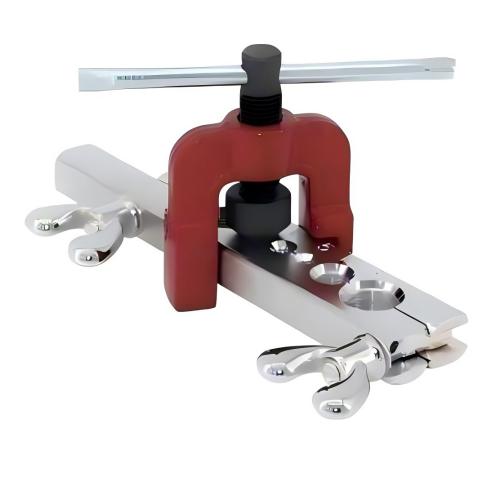
How to use the Flaring Tool:
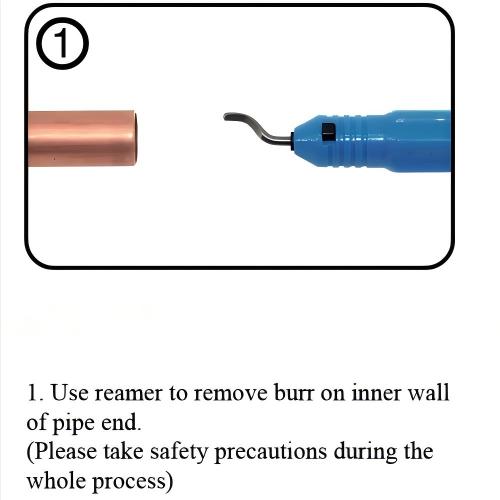
1) Deburing the tube
Use reamer to remove burr on inner wall of pipe end.(Please take safety precautions during thewhole process)
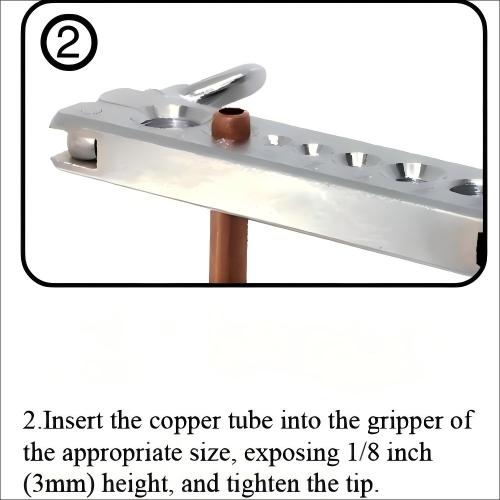
2)Insert the copper tube
Insert the copper tube into the gripper ofthe appropriate size, exposing l/8 inch(3mm) height, and tighten the tip.
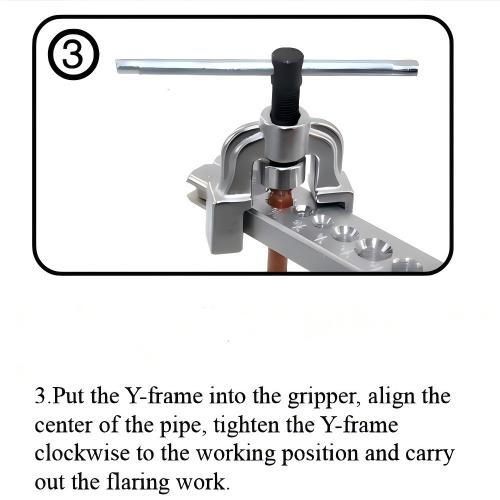
 3.Put the Y-frame into the griper.
Put the Y-frame into the gripper, align thecenter of the pipe, tighten the Y-frameclockwise to the working position and carryout the flaring work.
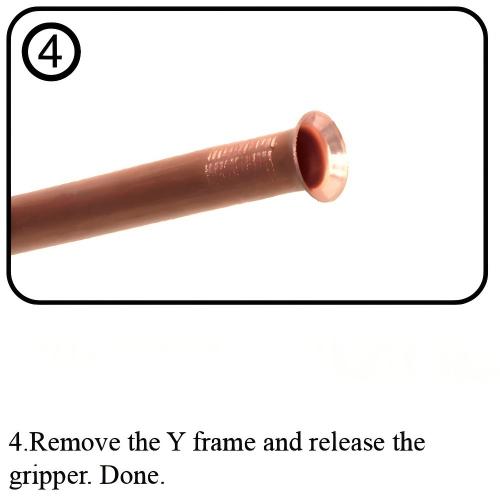
4. Release the gripper
Remove the Y frame and release the
gripper. Done.
Order Information & Inquiry Options
Choose whichever channel fits your buying process — we reply to all three within 12 hours, Monday to Saturday.
WhatsApp: +86 15867457689 — Amy
Email: amy@longrunhardware.com — for formal RFQ with target spec, quantity, destination port, and Incoterms (FOB Ningbo / CIF / DDP)
RFQ form: Request a Quote online — structured form, 15 fields, takes ~3 minutes
For OEM / private-label programs, please include your target spec, color, logo file (AI / PDF / PNG), retail box design, quantity, and destination port. Our export team will confirm specification, sample plan, lead time, and FOB / CIF pricing.
About the Author
Alisa Xu | Product Manager | Ningbo Torchmark Hardware Co., Ltd.
0086-13429254575 | Alisa Xu on LinkedIn
Choosing a 45-degree flaring kit for copper tube
This kit is listed with six flaring sizes from 3/16 in to 5/8 in and is sold into air conditioning, refrigeration and appliance repair channels. Most buyers arrive with the same three questions: whether their tube needs a single 45-degree cone or a double flare, whether the size range is wide enough for the work their customers actually do, and which part of the tool decides whether the flare holds. The answers below are written for distributors and private-label buyers who have to defend a tool choice to their own customers.
Single 45-degree cone or double flare
A single 45-degree cone is the standard joint on annealed copper tube in air conditioning and refrigeration work: the tube end is expanded once against the cone and clamped by the flare nut. A double flare folds the tube wall back on itself before forming the cone, which matters on thin-wall steel and on copper in high-pressure hydraulic service such as brake lines. The tool in this listing forms a single cone. If your customers are replacing brake lines or working on steel tubing above roughly 1/4 in, they need a double-flaring kit instead — see the 8-piece double flaring tool kit for that job, or the 34-piece brake line kit where the buyer wants adapters and bending bars in the same case.
Why 3/16 in to 5/8 in covers most HVAC work
Split-system and refrigeration pipework concentrates on 1/4 in, 3/8 in and 1/2 in outside diameter, with 5/16 in on some appliance and automotive lines and 5/8 in on larger condensing connections. A six-size kit therefore covers the joints a service technician meets in a normal week. Above 5/8 in the tube wall becomes stiff enough that a hand-held yoke struggles to form a clean cone, which is why the larger 45-degree tools are listed as separate models — the CT-203A and CT-203M cover 5/8 in to 1-1/8 in and 16 mm to 28 mm respectively.
The gripper block is the part that decides flare quality
Buyers tend to judge a flaring kit by the yoke, because it is the visible, heavy part. In service, most rejected flares trace back to the gripper block: if the two halves do not close squarely on the tube, the tube creeps forward under the cone and the flare comes out thin on one side. Check that the block closes without a visible gap on a tube at each end of the range, and that the wing nuts pull down evenly rather than one side first.
Flare style by tube material and wall thickness
| Tube in service | Joint type normally specified | What goes wrong with the wrong choice |
|---|---|---|
| Annealed copper, refrigeration and AC | Single 45-degree cone | Double flare wastes wall thickness and can split on small diameters |
| Hard copper, no annealing possible | Single 45-degree cone, anneal the end first if the joint weeps | Flare cracks at the cone shoulder because the metal will not flow |
| Mild steel brake and fuel line | Double flare (inverted) | A single cone work-hardens and cracks under pressure cycling |
| Thin-wall aluminium | Double flare where the fitting is inverted | Single cone cuts through the wall at the flare edge |
| Tube already assembled in a harness | Tool must reach the joint in place | Bench-only tools cannot be used without dismounting the line |
Setting tube height: the 1/8 in rule and where it fails
The instruction sheet that ships with this kit says to expose about 1/8 in (3 mm) of tube above the gripper block before forming. That figure is a starting point, not a specification. It is correct for the middle of the size range and drifts at both ends.
Why 3 mm is a starting point, not a spec
The right height scales with tube diameter: a 3/16 in tube needs less exposed length than a 5/8 in tube to form the same cone profile. If the tube sits too high the flare comes out oversized and the nut will not seat; too low and the cone is undersized and bottoms out before it seals. On a new size, form one scrap joint, measure the flare diameter against the fitting, and only then set a batch.
Deburr before clamping, every time
The burr left by a tubing cutter sits on the inside wall and is pushed into the cone seat during flaring. That single step accounts for a large share of weeping joints that pass a visual check. Ream the inside wall, then tap the tube end down so no chips remain in the bore. Any reamer that fits the bore works; a dedicated 45-degree tube reamer keeps the burr out of the fitting path. The cut itself matters as much as the ream: a cutter that rolls the wall inward leaves a burr no reamer can reach, and a large-diameter 168 mm tubing cutter is the usual pairing for 5/8 in and above.
Five failure modes and what each one means
The flare cracks at the shoulder
Either the copper is work-hardened and needs annealing before flaring, or the cone is being driven too far. Anneal to a dull red and let the tube cool in air, then re-form. If the crack appears on the first turn of the yoke, the tube grade is wrong for the application.
The flare is thin on one side
The gripper block is not closing square, or one wing nut is being tightened before the other. Seat both nuts by hand, then bring them down alternately. Check the block for a burr or a chip of copper lodged in the clamping groove.
The tube slides back out of the block
Clamping force is insufficient for the tube diameter, or the tube is oil-contaminated. Wipe the tube with a clean cloth and check that the block is the right size for the tube rather than one step larger.
The nut will not start on the finished flare
The flare is oversized, which almost always means too much tube was exposed. Cut the flare off, reset the height and form again; do not dress the flare down with a file.
The cone leaves a ring mark on the tube
Normal on the first few joints with a new tool, and it settles once the cone seats. A deep score line means the cone has picked up grit and should be cleaned before the next joint.
What to send with a quotation request
Flaring kits are quoted against the tube sizes the buyer will actually run, not against the size list alone. For an accurate quotation, send the tube outside diameters in your market, whether the dominant material is copper or steel, the joint type your customers specify, the packing format (blow case, colour box, double blister), the logo and card artwork if the kit is private label, and the destination port with the Incoterm you work on. Our OEM process page sets out how artwork approval, pre-production samples and mass production are sequenced.
Where the buyer is assembling a range rather than a single SKU, quote the cone kit alongside a double-flaring option and a bending bar set. That combination answers the three jobs a refrigeration distributor is asked for most often, and it keeps the case count per pallet efficient. The 7-hole double flaring kit is the usual second line for buyers who cannot carry a full brake-line assortment.
Questions buyers ask before ordering
Does this kit work on both inch and metric tube?
The sizes are inch, 3/16 in to 5/8 in. Metric tube is close but not identical, and the nearest inch size can weep. Specify metric at quotation stage.
Can the kit be used on tube already installed in a system?
Yes, if there is enough straight tube to clamp and room to swing the yoke a full turn. Inside a wall or a tight plant room, use a compact eccentric tool instead.
What is the difference from an eccentric flaring tool?
An eccentric cam forms the cone without swinging a yoke, so it is faster and needs less clearance. It costs more per set. See the FT-806AM-F eccentric kit.
Which sizes should a distributor stock first?
Run 1/4 in, 3/8 in and 1/2 in as the volume line, then hold 3/16 in and 5/8 in as the completion line. Automotive sellers add a double flare kit, not a second cone kit.
What packing formats are available?
Blow case, colour box and double blister with colour card. Packing drives carton quantity and freight, so settle it before the price is fixed rather than after.
How is the tool inspected before shipment?
Gripper block closure, yoke thread, cone finish and size marking are checked, then units are packed to the approved format. Ask for the inspection record with your first order.
Request a quotation or a sample kit
Send tube sizes, joint type, packing format and destination port and we will return a specification sheet with the quotation.
WhatsApp: +86 15867457689 (Amy) · Email: amy@longrunhardware.com for formal RFQs · alisa@longrunhardware.com for product and specification questions for samples and documentation. We reply to all three within 12 hours, Monday to Saturday.
Related reading: all tube flaring tool kits · hand tool sourcing FAQ · buying guides and how-tos.
Related Buying Guides
Specifying flaring tools for HVAC or brake line work? These guides explain flaring types, common field mistakes and metric/SAE sizing.
Questions buyers ask about flaring tool kits
What is the difference between a 45-degree and a 37-degree flare?
A 45-degree flare is the standard for plumbing, LPG and general tube work; a 37-degree (JIC/AN) flare is used for hydraulic, fuel and higher-pressure lines. Mixing the two leaks, so match the flare angle to the fitting you connect to, not to the tool you happen to own.
When should I use a double flare instead of a single flare?
Use a double flare on soft copper and aluminum brake or fuel lines where vibration and pressure can crack a single flare. A single flare is enough for stationary plumbing and HVAC connections that are torqued once and left alone.
Which flare is required for R410A HVAC connections?
R410A systems run at higher pressure, so a clean 45-degree single flare on annealed copper with proper flare-nut torque is standard; many techs prefer flared joints over compression for these pressures. Always use a proper flaring block and avoid nicks on the tube mouth.
How do I prevent leaks at a flare joint?
Cut the tube square, ream the inside, flare without cracks, and seat the flare nut with a calibrated torque rather than by feel. A tiny dab of refrigerant-compatible oil on the seat helps; never use pipe dope on a flare face. Inspect the cone for cracks before assembly.
What sizes do flaring tools cover, metric and imperial?
Most kits cover the common range: 1/4, 5/16, 3/8, 1/2, 5/8 and 3/4 in, plus 4, 6, 8, 10 and 12 mm. Confirm the mandrel set matches the tubing you stock so you are not one size short on a job.
How do I avoid cracking copper when flaring?
Use annealed (soft) copper, support the tube in the correct-size clamp without over-tightening, and rotate the yoke evenly. Work the mandrel in smoothly rather than forcing it; a cracked flare wastes the tube and risks a leak.
Double Blister and Color Card
Blowing Box