

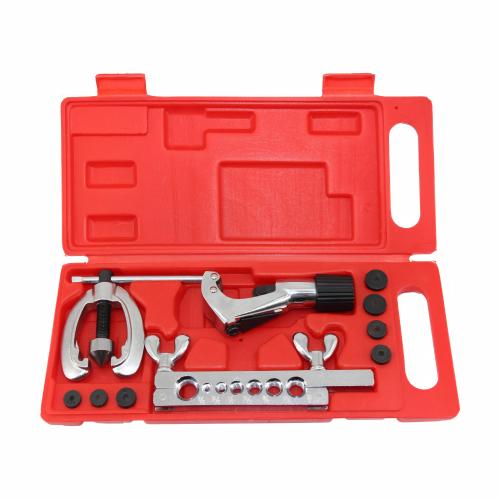
7-Hole Double Flaring Tool Kit
Confirm the supplied configuration before ordering
Request a quotation for the 7-hole double flaring tool kit with the required tube outside diameters, tube material, wall thickness and fitting specification. Ask for a written list of supplied bars, adapters and accessories, plus model-specific operating instructions. Confirm whether the quotation covers the inch or metric configuration, or both.
Match the tool to the required flare
Bubble flares and double/inverted flares are different connection requirements. Do not assume that a kit supports both. Confirm the required flare type and the supplied adapters before approving a sample or purchase order. Diameter coverage alone does not establish suitability for a brake, refrigerant or gas application.
Sample and order approval
Agree application requirements and sample acceptance criteria before ordering. Request any required inspection records for the specific configuration; no pressure-test result or leak-free performance is implied by this page.
Wholesale and mixed orders
Minimum order: 500 pieces. Mixed orders are available subject to confirmed allocation. Samples are charged; sample freight is refunded after an order is placed. Typical lead time is 15–45 days, subject to the confirmed order. Confirm logo and packaging options in your quotation.
Prepare a useful enquiry
Send your required diameters, flare type, quantities, destination and packaging needs. Contact Amy by email, WhatsApp +86 158 6745 7689 or our quotation form.
For selection questions, read our flaring tool buying guide. Compare other flaring tool kits before selecting a configuration.
Product reference images

About the Author
Alisa Xu | Product Manager | Ningbo Torchmark Hardware Co., Ltd.
0086-13429254575 | Alisa Xu on LinkedIn
Why the hole count is the first spec to confirm
A seven-hole bar is a compromise between coverage and clamp quality. Every extra hole removes material between the bores, and that material is what stops the bar from spreading when the cone is driven in.
Seven holes is not a standard list
Two factories can both sell a "7-hole" bar and hold different sizes. The count tells you how many bores there are, not which diameters they are. The only reliable confirmation is the written size list on the quotation.
Inch and metric bars are different parts
A metric bar and an SAE bar are machined to different bore diameters, so one bar does not properly clamp the other system's tube. If your market uses both, ask whether both bars ship in the kit or whether you have to choose.
Why buyers still prefer a fixed bar
A bar with fixed bores is cheaper, has no loose dies to lose, and is faster on a bench. An interchangeable-die set costs more but covers odd sizes. The right choice depends on what your customers work on, not on which sounds more complete.
Double flare, bubble flare and single flare are three different jobs
The page title says double flaring, and that word carries a specific meaning that is easy to lose in a catalogue listing.
| Flare type | How it is formed | Where it is used |
| Single 45° | Tube end opened once into a cone | Soft copper, HVAC and refrigeration |
| Double / inverted | End folded back, then formed, giving two wall thicknesses | Steel brake line, safety-critical joints |
| Bubble | End bulged into a rounded lip before flattening | Some brake and fuel line specifications |
A bar alone does not decide the flare type
The adapters and the cone do the forming. A bar with seven holes can be sold as a single-flare kit, a double-flare kit or a combination, and the piece list is what distinguishes them.
Why the distinction matters commercially
A buyer who orders a double-flare kit and receives single-flare tooling will reject the shipment, and the return cost lands on the distributor. Confirming the adapter list before the order is cheaper than resolving it after.
Which adapters have to be in the box
Buyers compare piece counts, but the useful comparison is which pieces are present. Four items decide whether the kit can do the work.
The folding adapter
The fold is what makes a double flare a double flare. Without this adapter the kit forms single flares only, whatever the listing says.
The cone
The cone is the wearing part that touches the tube. It should be hardened and finished smoothly, because a scored cone marks every flare it makes.
The yoke
The yoke drives the cone into the bar. If the yoke threads are loose or the yoke flexes, the cone enters off-axis and the flare comes out lopsided.
The cutter and reamer
A square cut and a deburred bore are what let a flare seal. Kits that include both remove a separate purchase and remove the most common cause of a leak.
Field failures and what actually causes them
Most flare complaints are preparation failures, not tool failures. Knowing which is which tells you whether to replace the tool or retrain the user.
The tube slips down in the bar
If the bar does not grip, the tube pushes down as the cone enters and the flare forms short. Setting tube flush with the bar face and tightening evenly is the fix.
The flare cracks at the edge
Cracking usually means the tube was cut with a wheel that work-hardened the end, or the end was not deburred. It is rarely a cone problem.
The flare is lopsided
An off-centre flare points at the yoke rather than the cone. Check that the yoke seats squarely on the bar before blaming the tooling.
The flare is too shallow or too deep
Depth is set by how far the cone is driven. A stop or a marked depth makes repeatable flares far easier than judging by eye.
When a seven-hole kit is the wrong choice
Naming the limits of a configuration is cheaper than handling a return.
Hydraulic work at 37 degrees
JIC and AN hydraulic fittings use a 37-degree flare. A 45-degree set produces a flare that looks acceptable and does not seal.
Large-diameter or thick-wall tube
Bigger tube needs more clamping force and a heavier yoke than a seven-hole bar is built for. Bench-mounted tooling is the right recommendation there.
Stainless and hard tube
Stainless work-hardens as it forms and generally needs hydraulic or bench tooling. A hand kit sold for stainless will generate complaints.
Copper-only HVAC work
Copper takes a single 45-degree flare. Paying for double-flare adapters that will never be used is wasted budget for an HVAC-only customer.
What to confirm on a sample before a volume order
Four checks on one sample cover the failures that show up at scale.
Get the written size list
Ask for the seven diameters in writing, in both inch and metric if both bars are supplied. Match it against what your market actually fits.
Form one flare in every hole
Work through all seven bores on scrap tube. A bore that nominally exists but will not clamp is the defect worth finding on a sample rather than in a container.
Section one flare
Cut a formed flare lengthways. The fold should be even on both sides and the wall should not be thinned to a knife edge.
Seat it on a real fitting
Thread the matching nut on and tighten it. The flare should sit fully on the fitting cone rather than bottoming out early.
Questions buyers ask about the 7-hole double flaring kit
Which seven sizes does the bar hold?
The count does not fix the diameters, so ask for the written list in inch and metric. Two suppliers can both call it seven-hole and ship different coverage.
Does it form both double and bubble flares?
Only if the adapters are included. Bubble and double flares use different forming steps, and the piece list on the quotation is the only reliable confirmation.
Can one bar cover inch and metric tube?
Not accurately. Bores are machined to one system, so a metric bar will not clamp an inch tube properly. Ask whether both bars ship or whether you choose one.
Will it work on copper tube?
Yes, but copper needs only a single 45-degree flare. Doubling copper is unnecessary work, and an HVAC buyer is better served by single-flare tooling.
What causes a cracked flare?
Usually the cut and the deburr rather than the tool. A wheel-cut end that was not reamed tends to split, so fix the preparation before replacing the cone.
Can we add our brand and artwork?
Logo, colour and retail artwork are OEM options quoted against the configuration. Raise it at the enquiry stage because artwork approval affects the lead time.
Request a quotation for the 7-hole kit
Send the tube sizes to be covered, inch or metric, the flare types required, quantity and destination, and we will return the configuration list and a quotation. Email amy@longrunhardware.com, alisa@longrunhardware.com, or message us on WhatsApp at +86 158 6745 7689. Product Manager Alisa Xu handles this range. Smaller brake line kits are on the 8-piece double flaring kit page, larger sets on the 34-piece page and the BLF-24 page, and the eccentric alternative is on the FT-806AM-F page. The full range sits under tube flaring tool kits. HVAC flare geometry is explained in the leak-free HVAC flare guide, sizing pitfalls in the inch versus metric guide, and OEM terms are listed on the OEM process page.
Related Buying Guides
Specifying flaring tools for HVAC or brake line work? These guides explain flaring types, common field mistakes and metric/SAE sizing.
Questions buyers ask about flaring tool kits
What is the difference between a 45-degree and a 37-degree flare?
A 45-degree flare is the standard for plumbing, LPG and general tube work; a 37-degree (JIC/AN) flare is used for hydraulic, fuel and higher-pressure lines. Mixing the two leaks, so match the flare angle to the fitting you connect to, not to the tool you happen to own.
When should I use a double flare instead of a single flare?
Use a double flare on soft copper and aluminum brake or fuel lines where vibration and pressure can crack a single flare. A single flare is enough for stationary plumbing and HVAC connections that are torqued once and left alone.
Which flare is required for R410A HVAC connections?
R410A systems run at higher pressure, so a clean 45-degree single flare on annealed copper with proper flare-nut torque is standard; many techs prefer flared joints over compression for these pressures. Always use a proper flaring block and avoid nicks on the tube mouth.
How do I prevent leaks at a flare joint?
Cut the tube square, ream the inside, flare without cracks, and seat the flare nut with a calibrated torque rather than by feel. A tiny dab of refrigerant-compatible oil on the seat helps; never use pipe dope on a flare face. Inspect the cone for cracks before assembly.
What sizes do flaring tools cover, metric and imperial?
Most kits cover the common range: 1/4, 5/16, 3/8, 1/2, 5/8 and 3/4 in, plus 4, 6, 8, 10 and 12 mm. Confirm the mandrel set matches the tubing you stock so you are not one size short on a job.
How do I avoid cracking copper when flaring?
Use annealed (soft) copper, support the tube in the correct-size clamp without over-tightening, and rotate the yoke evenly. Work the mandrel in smoothly rather than forcing it; a cracked flare wastes the tube and risks a leak.
Small trial orders for flaring configurations
If you are adding flare tools to your range, a small trial order covering the tube sizes and cone types you actually stock is enough to check fit and demand. The applicable minimum is confirmed for each item in the quotation.
Send the tube diameters, the 45° SAE or 37° JIC cone you need, and your first-order quantity, and we will confirm the matching configuration, packing and terms per order.
Packaging confirmation for wholesale orders
Before approving a purchase order, ask Ningbo Torchmark Hardware Co., Ltd. to confirm the packaging for your selected 7-hole double flaring tool kit configuration.
Contents: confirm the flaring bar, yoke, adapters and any additional accessories against the quotation and approved sample.
Individual pack: confirm whether a case is included, its layout, closure and the arrangement of each component.
Shipping data: request the final sets per carton, carton dimensions, net weight and gross weight for freight planning. These details must match the ordered configuration.
Protection: agree the internal protection and carton requirements for your shipping route; approve a packing sample where needed.
Private label: confirm logo placement, barcode, instructions, artwork and any additional cost before production.
The minimum order quantity is 500 pieces. Mixed orders are possible; confirm the quantity allocated to each model in the quotation. Samples are charged, with sample freight refunded after an order is placed. Typical lead time is 15–45 days, subject to the confirmed order and packaging requirements.
Send the model, quantity and destination to amy@longrunhardware.com or WhatsApp +86 158 6745 7689 for a packing confirmation and quotation.