How to Choose a Rivet Nut Tool Kit for Wholesale and Industrial Use
How to Choose a Rivet Nut Tool Kit for Wholesale and Industrial Use
A rivet nut tool may look straightforward, but choosing the right kit for a wholesale or industrial program requires more than comparing handle length and price.
Buyers must consider the target application, required thread sizes, rivet nut materials, tool leverage, mandrel availability, kit contents and packaging. A low-cost kit can quickly become an expensive sourcing decision if its mandrels do not match the local market, the tool cannot set the required inserts or the accessories move out of position during transportation.
For distributors, hardware importers, industrial suppliers and private-label brands, the goal is therefore not simply to find a manual rivet nut gun. The goal is to source a complete, market-ready kit that delivers consistent installation performance and can be supplied repeatedly under an agreed specification.
This guide explains how to evaluate a rivet nut tool kit before requesting samples or placing a volume order.
What Is a Rivet Nut Tool Kit?
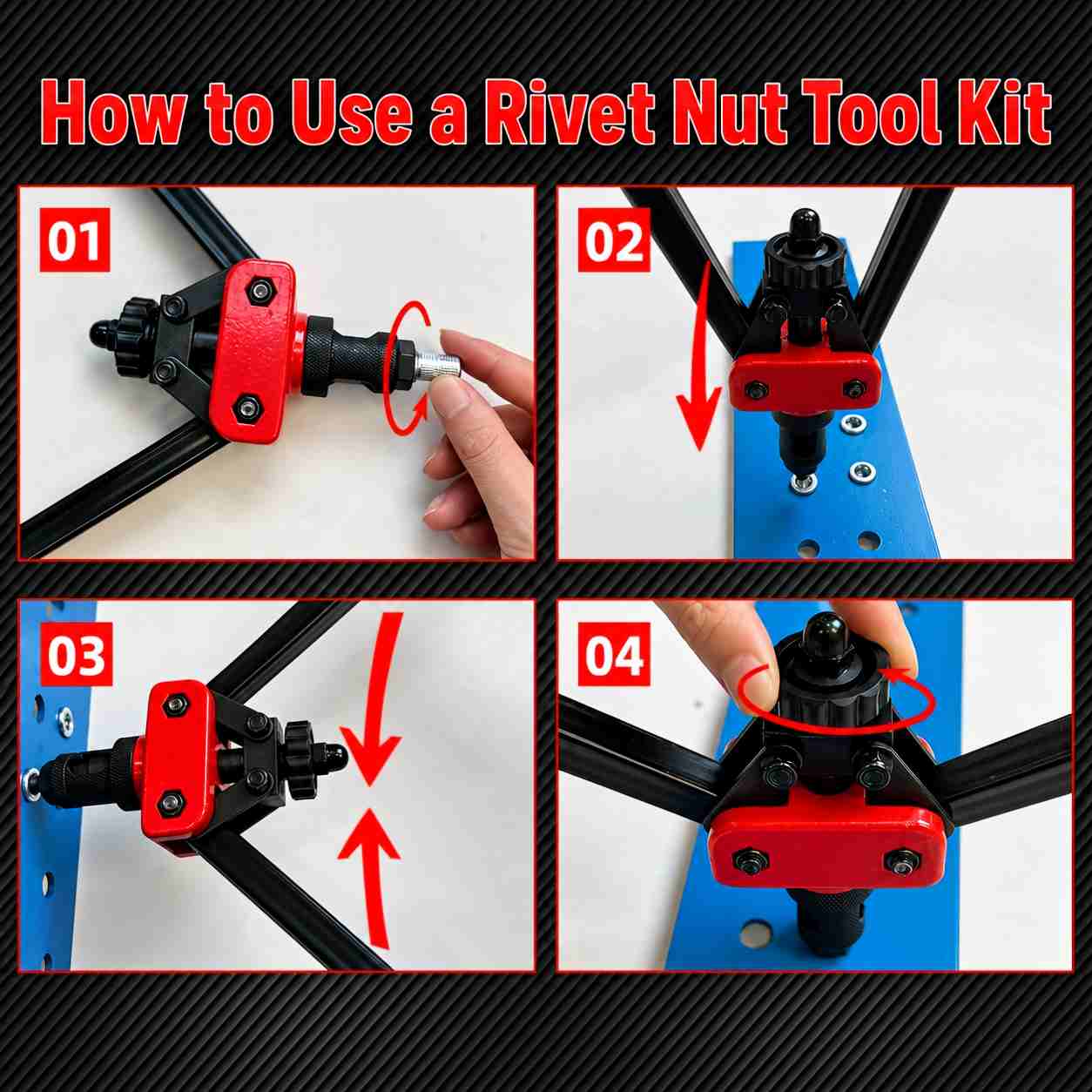
A rivet nut tool kit is used to install internally threaded inserts in materials where access may be available from only one side. Once installed, the rivet nut provides a reusable threaded mounting point for a bolt or other threaded component.
A typical manual kit may include:
A long-handle rivet nut tool
Interchangeable threaded mandrels
Assorted rivet nuts
One or more adjustment wrenches
A molded carrying case
Compared with buying individual components separately, a complete kit gives distributors a more convenient product for retail, workshop and maintenance channels. It also helps end users keep the tool, mandrels and small accessories organized.
However, kit contents vary between suppliers. Buyers should never assume that two products described as a “150-piece rivet nut tool kit” contain the same mandrel sizes, insert materials or quantities.
Why Tool Selection Matters for Wholesale Buyers
An individual user may purchase a tool for one repair. A wholesale buyer must consider hundreds or thousands of units that need to meet the same approved specification.
A poorly selected wholesale rivet nut tool can create several commercial problems:
Returns caused by unsuitable thread sizes
Broken or prematurely worn mandrels
Inconsistent insert setting
Missing components or incorrect kit quantities
Damaged retail packaging
Dead inventory caused by the wrong product configuration
Customer complaints about unclear instructions
Delays when replacement mandrels are unavailable
The correct product should match both the technical application and the expectations of the target sales channel.
For example, automotive repair shops and fabrication workshops may prioritize leverage, durability and replacement mandrels. Retail buyers may place more value on complete kit presentation, clear size identification and a well-organized carrying case. Private-label programs must also consider logo application, instruction language and packaging artwork.
Key Specifications to Compare
Before selecting an industrial rivnut tool, prepare a specification sheet that allows candidate products and suppliers to be compared on the same basis.
| Specification | What the buyer should confirm | Why it matters |
|---|---|---|
| Tool type | Manual, pneumatic, battery-powered or hydraulic | Determines cost, working speed and intended application |
| Handle length | Overall tool length and usable leverage | Longer handles can reduce operator effort during manual installation |
| Thread system | Metric, inch or a combination | Must match the fasteners used in the destination market |
| Mandrel range | Exact sizes included in the kit | Prevents incompatibility with the required rivet nuts |
| Insert materials | Aluminum, steel or stainless steel | Different materials can require different setting forces |
| Kit contents | Tool, mandrels, wrench, rivet nuts and accessories | Ensures quotations are based on the same configuration |
| Case design | Component layout and retention | Protects the contents during storage and transportation |
| Spare parts | Mandrels, nosepieces and service components | Supports long-term use and after-sales requirements |
| Packaging | Carrying case, retail box, label and master carton | Affects retail presentation and export handling |
| OEM options | Logo, color, instructions and packaging artwork | Important for private-label and distributor programs |
Choose the Tool Type for the Intended Application
Manual, pneumatic and battery-powered tools serve different purchasing requirements.
Manual rivet nut tools
A manual rivet nut gun is portable, requires no air supply or battery and is suitable for repair, maintenance, installation and low-to-medium-volume work. It is often a practical option for distributor catalogs because it can serve automotive, HVAC, sheet-metal and general fabrication customers.
Long-handle manual tools provide additional leverage compared with compact designs. This can make insert setting more controlled, particularly when the operator works with larger rivet nuts or harder insert materials.
However, the required operating force still depends on the thread size, insert material and workpiece. Buyers should test the actual configuration instead of selecting a tool based only on handle length.
Pneumatic and battery-powered tools
Pneumatic or battery-powered tools may be more suitable for production environments with a high number of repeated installations. They can improve installation speed but usually involve a higher purchasing cost, more maintenance considerations and additional operator training.
Wholesale buyers should match the tool type to the customer group rather than assuming that a more expensive tool is automatically the better product.
Confirm Mandrel and Thread Sizes
Mandrel selection is one of the most important parts of sourcing a rivet nut tool kit.
The supplier should clearly identify:
Every mandrel size included
Whether the sizes are metric or inch
The compatible nosepiece for each mandrel
The recommended rivet nut material
The availability of replacement mandrels
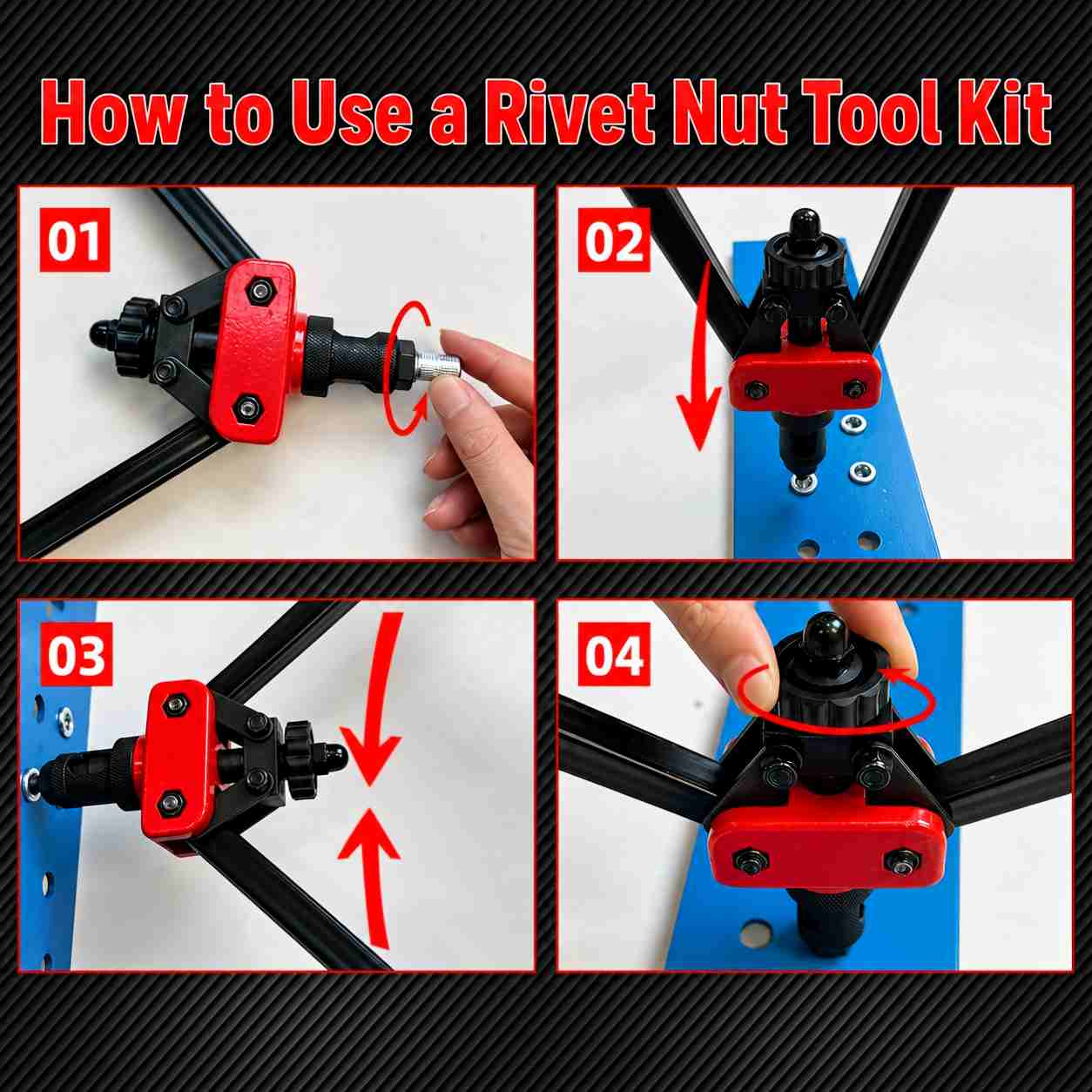
The method for adjusting and changing mandrels
Thread preferences vary by country and industry. A metric kit may be appropriate for one market, while another distributor may require inch sizes or a customized combination.
Ask the rivet nut tool supplier to provide a complete packing list instead of relying on a general product name. The list should show the size and quantity of every mandrel, rivet nut and accessory.
Match the Tool to the Rivet Nut Material
Rivet nuts are commonly produced from aluminum, steel and stainless steel. These materials do not require identical installation force.
Aluminum inserts are generally easier to set, while steel and stainless-steel inserts may place greater demands on the tool and mandrel. Tool compatibility should therefore be confirmed for the exact rivet nut size and material required by the buyer.
Before approving a sample, provide the supplier with:
The required thread sizes
The rivet nut body style
The insert material
The workpiece material and thickness
The expected installation frequency
Avoid descriptions such as “suitable for all rivet nuts” unless the claim is supported by a defined size and material range.
Evaluate the Complete Kit, Not Only the Tool
For a kit product, quality inspection must cover every supplied component.
A complete evaluation should include:
The main tool
Every interchangeable mandrel
Every matching nosepiece
The adjustment wrench
The assorted rivet nuts
The molded case
Labels and instruction materials
Retail and export packaging
Verify that the quantities match the approved packing list. Small accessories should remain securely positioned when the closed case is carried, rotated and transported.
The carrying case also affects the perceived value of the product. Check the hinge, latches, handle, component recesses and overall fit. A strong tool in a poorly designed case can still lead to negative customer feedback.
Sample Checks Before a Bulk Order
Never approve a volume order based only on photographs or a general catalog description. Request a representative sample configured with the same components, inserts and packaging intended for production.
Check the mandrels
Inspect the threading and confirm that each mandrel can be installed and removed correctly. Test the mandrels with the specified rivet nut sizes and materials.
Check stroke adjustment
The tool should allow the operator to set an appropriate stroke for the chosen insert. Incorrect adjustment may result in an under-set insert, damaged threads or excessive stress on the mandrel.
Check handle alignment and pivot movement
Open and close the handles repeatedly. Movement should be controlled and consistent, without abnormal looseness, binding or misalignment.
Check insert setting and release
Install the rivet nut in a representative workpiece. Confirm that the insert is securely set and that the mandrel can be released without damaging the internal thread.
Check every kit component
Compare the sample against the approved packing list. Verify sizes, quantities, markings, accessory placement and case organization.
Check the packaging
Review the retail box, instruction language, barcode, labels and shipping marks. For private-label orders, approve dated artwork before production begins.
Questions to Ask a Rivet Nut Tool Supplier
A professional sourcing discussion should go beyond unit price. Ask potential suppliers the following questions:
What mandrel sizes are included in the quoted kit?
Are the threads metric, inch or customizable?
Which aluminum, steel or stainless-steel inserts are compatible?
Are replacement mandrels available?
Can the packing list be customized for our market?
What sample inspections are completed before shipment?
Can the tool color and logo be customized?
Are multilingual instructions available?
Can you provide retail packaging and master-carton marks?
What are the MOQ and lead time for the selected configuration?
How are missing, damaged or nonconforming components handled?
Can a pre-production sample be approved before volume manufacturing?
Clear written answers make it easier to compare suppliers and reduce misunderstandings after an order is placed.
OEM and Private-Label Considerations
An OEM rivet nut tool program involves more than adding a logo to the handle.
Depending on the project, buyers may need to confirm:
Tool and handle colors
Logo position and marking method
Mandrel size markings
Custom packing-list configuration
Retail-box design
Instruction language
Barcode and product labels
Master-carton markings
Destination-market warnings
Spare-part arrangements
Final availability, minimum order quantity and production lead time can depend on the selected tool, components and packaging.
Approve a representative sample and dated artwork before mass production. The approved files should clearly identify colors, logo dimensions, packaging text and every item included in the kit.
The LR-HR-09 as a Wholesale Kit Example
The LR-HR-09 14-inch rivet nut tool kit is designed for distributors, hardware importers, repair-tool suppliers and private-label programs.
Its standard product concept includes:
A 14-inch manual long-handle rivet nut tool
Interchangeable mandrels
Assorted rivet nuts
An adjustment wrench
A blow-molded carrying case
A 150-piece kit configuration
Typical applications include automotive repair, HVAC installation, sheet-metal work, equipment maintenance and general workshop use.
Because thread requirements differ between markets, buyers should confirm the required metric or inch mandrels and the intended aluminum, steel or stainless-steel inserts when requesting a quotation.
OEM discussions can also cover tool color, logo marking, multilingual instructions, retail-box artwork and master-carton marks.
Practical Sourcing Steps
A structured purchasing process helps buyers compare products fairly and control repeat-order quality.
Step 1: Define the target market
Identify whether the kit will be sold to professional workshops, industrial maintenance teams, automotive repair shops, HVAC installers or retail users.
Step 2: Prepare the technical specification
List the required tool type, length, mandrel sizes, thread system, rivet nut materials, kit contents and packaging.
Step 3: Request a detailed quotation
The quotation should identify the exact configuration instead of referring only to a general model or piece count.
Step 4: Evaluate a representative sample
Test the product using the same insert sizes and materials expected in the destination market.
Step 5: Approve the packing list and artwork
Confirm all components, quantities, labels, instructions and packaging files.
Step 6: Establish inspection criteria
Define the functional, visual, dimensional and packaging checks that will be used for production.
Step 7: Confirm repeat-order controls
Ensure that future orders will follow the same approved specification and revision level.
Common Sourcing Mistakes to Avoid
Wholesale buyers should avoid several recurring mistakes:
Choosing a kit based only on the lowest price
Failing to specify metric or inch threads
Testing only aluminum inserts when steel inserts will be sold
Comparing kits with different contents as if they were identical
Ignoring replacement mandrel availability
Approving a tool without testing the carrying case
Starting production before approving packaging artwork
Leaving quality requirements out of the purchase order
Assuming all 150-piece kits have the same configuration
A detailed RFQ prevents many of these problems before price negotiation begins.
Key Takeaways
The best rivet nut tool kit is not necessarily the model with the largest number of accessories or the lowest quoted price. It is the kit that matches the target market, required thread sizes, insert materials and sales channel.
Before placing a wholesale order:
Confirm the tool type and handle length
Specify metric or inch mandrel sizes
Identify the required rivet nut materials
Review the complete packing list
Test a representative sample
Inspect the case and packaging
Confirm replacement mandrel availability
Approve OEM artwork before production
Record the final specification in the purchase order
These steps help distributors reduce returns, maintain consistent quality and build a more reliable industrial rivnut tool program.
Frequently Asked Questions
What should be included in a rivet nut tool kit?
A typical kit includes a manual rivet nut tool, interchangeable mandrels, matching nosepieces, assorted rivet nuts, an adjustment wrench and a carrying case. The exact sizes and quantities should be confirmed through a detailed packing list.
Is a long-handle rivet nut tool better for industrial use?
A long-handle tool can provide additional leverage for manual installation. However, suitability depends on the rivet nut size, material and installation frequency. Buyers should test the actual inserts required for their market.
Can one manual rivet nut gun install every type of rivet nut?
No universal assumption should be made. Compatibility depends on the tool’s mandrel range, thread system and the size and material of the insert. Always obtain a confirmed compatibility range from the supplier.
Should I choose metric or inch mandrels?
Choose the thread system used by your customers and destination market. Some wholesale programs may require a customized kit containing a specific combination of sizes.
Why is the packing list important for a 150-piece kit?
The piece count alone does not explain which sizes, materials and quantities are included. A packing list allows buyers to compare quotations accurately and inspect production against the approved configuration.
What should I test before ordering in bulk?
Test mandrel threading, stroke adjustment, handle alignment, pivot movement, insert setting and mandrel release. Also inspect every accessory, the molded case and the final packaging.
Can rivet nut tool kits be customized for private-label sales?
Depending on the selected configuration and order quantity, customization may include tool color, logo marking, instruction language, retail-box artwork and master-carton marks. Confirm availability with the supplier before approving the order.
What information should be included in an RFQ?
Include the required thread sizes, metric or inch system, rivet nut materials, kit contents, packaging requirements, logo requirements, order quantity and destination. This gives the supplier enough information to prepare a more accurate quotation.
Request a B2B Quotation
Looking for a wholesale rivet nut tool, industrial kit or private-label fastening solution?
Review the LR-HR-09 14-inch 150-piece rivet nut tool kit and send your required thread sizes, insert materials, kit contents, order quantity, packaging requirements and destination.
A detailed RFQ allows the supplier to confirm the appropriate configuration, sample plan and quotation more efficiently.
Author: Alisa Xu, Product Manager
Connect with Alisa Xu on LinkedIn
 How to Choose a Rivet Nut Tool Kit for Wholesale and Industrial Use
 Metric vs SAE Flaring Tool Kits: B2B Buying Guide
 Manual Oil Can Manufacturer: OEM Sourcing Guide for Distributors