
Threaded Stud Bolts Buying Guide: ASTM / ISO Grade, Thread Pitch and Finish for B2B Procurement
Threaded Stud Bolts Buying Guide: ASTM / ISO Grade, Thread Pitch and Finish for B2B Procurement
If you write industrial bolt schedules for a living — refinery, shipyard, wind farm, OEM machinery — the question that keeps coming back is the same: do I spec a stud bolt, a hex bolt, or a length of threaded rod? And once you answer that, the next question is which grade, which thread, which finish. This guide is written for procurement engineers, technical buyers and OEM programme managers who need a clean shortlist of decisions and the engineering rationale behind each one.
Throughout the guide we cross-reference our production range, the TR-STS threaded stud bolt, which covers the four most common ASTM / ISO material grades and runs from M6 to M64 with thread systems in UNC, UNF, metric coarse and metric fine. Where the guide talks about specific dimensions, tolerances or plating options, those are pulled directly from the public standard publications listed at the end.
1. Why a stud bolt, in one paragraph
A stud bolt is a headless bar with machine threads on each end and a smooth (or partially smooth) shank in the middle. That geometry is what gives it three engineering advantages over a hex bolt and a length of threaded rod: (a) both sides of a flange or tapped joint can be tightened by torquing the nut, with no need to swing a wrench over the head — important where the head access is restricted; (b) the plain shank in the middle bears the shear load without crushing the threads; (c) when the joint has to be disassembled for service, one stud and two nuts come out faster than a hex bolt with a captive head. For OEM and wholesale stocking, studs also win on flexibility: one length can be used across several flange thicknesses because it can be cut to size, reducing SKUs.
2. Picking the right material grade
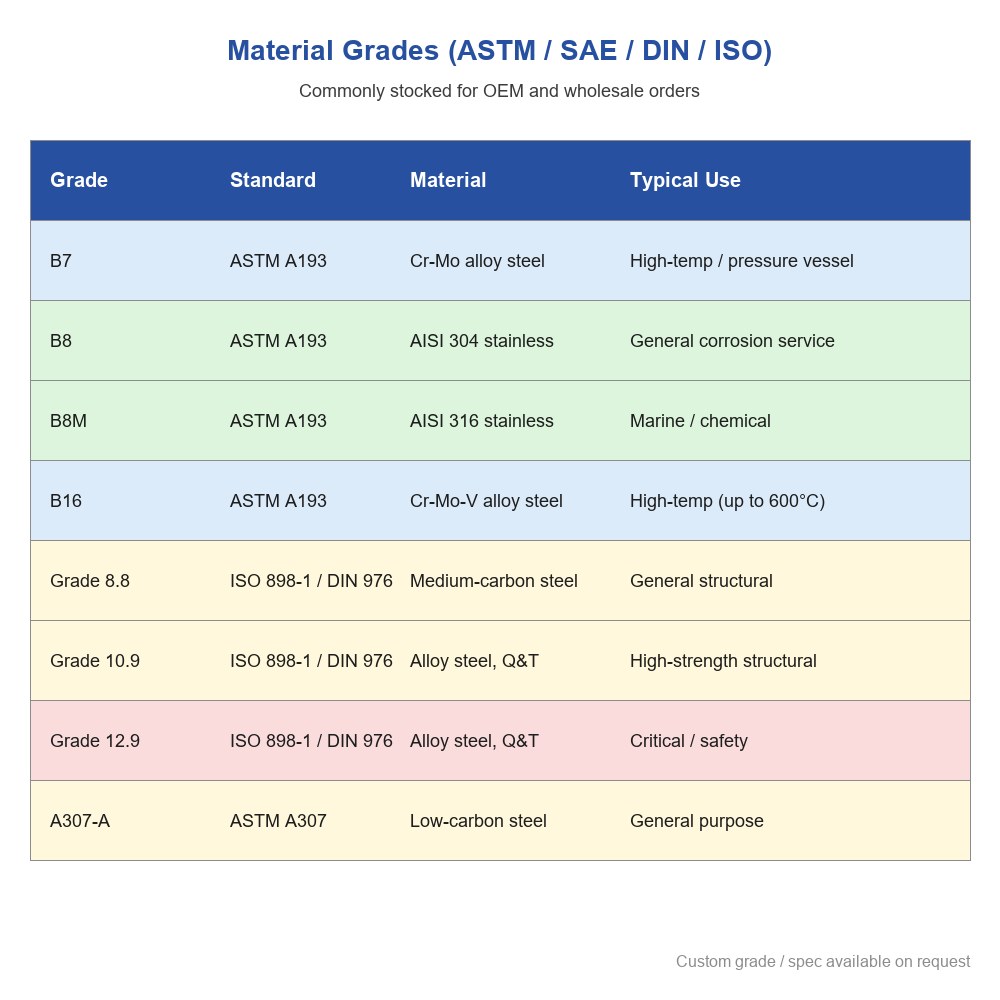
The grade you specify determines the temperature window, corrosion allowance and mechanical performance of the joint. We carry the four grades most frequently called out by B2B buyers in RFQs below.
ASTM A193 B7 — alloy steel, the refinery and boiler default
B7 is a quenched-and-tempered chromium-molybdenum alloy steel with a minimum tensile strength of 860 MPa and a hardness range of HRC 22–32. It is the workhorse choice for pipe flanges, valve bodies, heat-exchanger heads and boiler casings running up to roughly 450 °C. B7 is not corrosion-resistant by itself — pair it with hot-dip galvanising (HDG, 50–80 µm) for outdoor service or zinc plating for indoor service. If the joint sees a sour (H₂S) environment, ask for an NACE MR0175-compliant variant.
ASTM A193 B8 / B8M — 304 / 316 stainless for general and marine service
B8 is AISI 304 stainless (Class 1 = 700 MPa tensile, Class 2 = 860 MPa after strain-hardening). B8M is AISI 316 (with 2–3 % molybdenum for chloride pitting resistance). Both are the right call for any joint where corrosion beats cost — food and beverage equipment, water systems, marine hardware, chemical plants. B8M is the spec you want on offshore platforms, in seawater-cooled pump casings, or anywhere splash-zone salt is a constant.
ASTM A193 B16 — chromium-moly-vanadium, high-temperature up to 600 °C
B16 is reserved for the hottest service — high-pressure steam lines, turbine casings, large boiler flanges. It keeps its strength at temperatures that would temper B7.
ISO 898-1 grades 8.8 / 10.9 / 12.9 — metric property classes for structural use
Outside the U.S. petroleum / petrochemical sector, most structural studs are specified to ISO 898-1. The class number follows a load / 100 convention: a 10.9 stud has a tensile strength of 1,000 MPa. Use 8.8 for general structural, 10.9 for high-strength structural (mining equipment, mobile plant, automotive chassis), and 12.9 for safety-critical joints (lifting gear, vehicle suspension, machine-tool slides). For an OEM programme that services both markets we typically run two parallel specs: ISO 898-1 metric for general structural and ASTM A193 for pressure / thermal.
ASTM A307 Grade A — the cheap and cheerful fallback
A307-A is a low-carbon steel grade for general-purpose studs where high strength is not required — anchor bolts, low-pressure pipe flange connections, tie-downs. Tensile ≥ 415 MPa. The price is roughly half of B7, but the headroom for elevated-temperature or dynamic load is much smaller. If your joint sees more than a static load, move up to B7 or 8.8.
3. Thread system and pitch
The thread system follows from where the equipment is built and what the engineering spec uses. There is no engineering advantage to picking one over the other — they have been designed to perform equivalently — but you cannot mix systems on the same joint without a thread adaptor.
- UNC (Unified National Coarse) — the default imperial coarse per ASME B1.1, e.g. 1/2″-13, 3/4″-10. Quick to assemble, robust to minor thread damage.
- UNF (Unified National Fine) — finer pitch, e.g. 1/2″-20. Used where vibration could loosen the joint or where fine length adjustment is required.
- Metric Coarse — the default per ISO 261 / ISO 965-1, e.g. M12 × 1.75, M20 × 2.5. Stocked universally in ISO 898-1 grades.
- Metric Fine — for thin-wall joints, vibration service or fine adjustment. e.g. M12 × 1.5.
Custom thread systems (BSW, BSF, BA, ACME, left-hand) are quoted per drawing. Note that two threads of the same nominal size but different pitches do not interchange: a 1/2″-13 stud will not seat into a 1/2″-20 tapped hole.
4. Length and thread-run
Stud length is the overall length under the head — for a headless stud, end-to-end. Default thread run per ISO 976 and ASME B18.31.1 is roughly 2 × nominal diameter + 6 mm at each end. For an M16 stud, expect about 38 mm of thread each end. Custom thread runs are common for OEM:
- Full thread — useful where the joint tolerance is unknown and the stud has to be paired with a captured nut on each side.
- Three-quarter thread — leaves a quarter of the shank plain on one end. Useful for stud welding.
- Single-end thread — one end threaded, the other reduced-diameter shank for swaging or upsetting. Special order.
For flange calculations, the simplest rule of thumb is stud length = 2 × flange thickness + gasket + 2 × washer + 2 × nut height + 2 mm clearance. Send us a flange stack-up sketch and we will specify the length and torque for the joint directly.
5. Surface finish
Surface finish is one of the main levers for service life. The four finishes B2B buyers spec most often are:
- Plain black (oiled) — cheapest. Indoor structural, low humidity.
- Zinc-plated (5–8 µm) — neutral indoor / sheltered-outdoor service. 48 h NSS to ASTM B117.
- Hot-dip galvanised (50–80 µm) — outdoor structural and road / bridge work. ≥ 500 h NSS to ASTM B117.
- PTFE / Xylan — chemical service, anti-galling, threads that have to release after thermal cycling.
For marine and offshore service, jump to HDG B7 or 316 stainless (B8M); thin zinc plating is not enough for splash-zone service. For European retail and electrical equipment, use mechanical zinc + trivalent chromate to meet RoHS requirements.
6. Quality control — what an MTC must include
Every stud-bolt shipment should be paired with a mill test certificate (MTC) that identifies the heat of steel and the test results. The default is EN 10204 3.1; for project-grade work, insist on EN 10204 3.2 with third-party inspection from a recognised body (BV, SGS, TÜV).
The test panel we run per lot:
- Hardness — Rockwell C on the shank. Targets B7 = 22–32, 10.9 = 26–34, 12.9 = 39–44.
- Tensile — full-section per ASTM A370 / ISO 6892-1.
- Salt spray — ASTM B117 on a sacrificial sample per finish.
- Proof load — per ASME B18.31.1.
- Dimensional — 100 % sampling with a thread Go / No-Go gauge.
- Chemical — spectro per ASTM A751.
If you are quoting a project, attach the relevant test requirements to the schedule; the MTC format we prepare will mirror your data sheet for upload straight into your QA system.
7. Typical application checklist
The table below is the matrix we send to new distributor accounts during onboarding. Use it to shortlist a grade and finish before approaching us for a quotation.
| Service environment | Suggested grade | Finish | Notes |
|---|---|---|---|
| Refinery, ≤ 400 °C, indoor | B7 | Plain black / zinc | MTC 3.1 with each lot |
| Refinery, ≤ 600 °C | B16 | Plain black | MTC 3.1; impact test optional |
| Outdoor structural / bridge | B7 or 8.8 | HDG | 500 h NSS minimum |
| Marine splash zone | B8M (316) | — | Passivation on request |
| Heavy equipment chassis | 10.9 or 12.9 | Phosphate / zinc | Mating nut and washer set |
| Wind tower flange | B7 or 10.9 | HDG or zinc-flake | MTC + impact per project spec |
| Concrete anchor (cast-in) | 8.8 or A307-A | Plain or zinc | Bent end per drawing |
| Cryogenic / LNG | A320 L7 / L43 | Plain or zinc | Impact-tested at –46 °C / –101 °C |
8. Packaging, labelling and stock programmes for wholesalers
For the wholesale channel, packaging is half the unit-cost equation. Our four standard formats:
- 25 kg bulk bag (woven polypropylene + plastic liner).
- 20–25 kg export carton (5-ply corrugated, ISPM-15 heat-treated pallet).
- Retail box with EAN-13 barcode (10 / 25 / 50 pcs per box depending on length).
- Blister / hanging card for in-store pegboard.
For long-term distributor accounts we set up a stocking agreement: we hold a buffer of 3,000–10,000 pcs at our warehouse for a defined length × grade × diameter range and ship ex-stock within 24 hours against your release orders. The stock levels reset every quarter against actual call-off.
9. How to write a clean RFQ
The fastest way to get a quote from us (or any stud-bolt supplier) is a five-line schedule. One line per variant; columns from left to right:
- Diameter × Length. e.g. M16 × 100 mm, or 3/4″ × 4″.
- Grade. ASTM A193 B7, ISO 898-1 10.9, ASTM A307-A, etc.
- Thread. Metric coarse / fine, UNC / UNF.
- Finish. Plain, zinc, HDG, PTFE, etc.
- Quantity per size. Per carton, per pallet, total pcs.
If the schedule is part of a project with a defined flange stack-up, attach the sketch and we will specify the stud length and recommended torque. The cleaner the schedule, the cleaner the quotation.
10. Frequently asked questions
What is a stud bolt used for?
A stud bolt is used in any joint that has to be repeatedly tightened and loosened — pipe flanges, valve bonnets, pump casings, hydraulic manifolds, heat-exchanger heads, and anchor points for concrete-set tie-downs. The headless geometry with two nuts lets you torque either side of the joint without a wrench over a head.
What is the difference between a stud bolt and a hex bolt?
A stud bolt is headless with threads on both ends and a plain shank in the middle. A hex bolt has a hex head and is partially threaded along a single shaft from the head down. Studs are better for joints with restricted head access or where the joint has to come apart for service. Hex bolts are cheaper and faster for through-hole structural connections.
What is the difference between a stud bolt and a threaded rod?
A threaded rod is fully threaded along its entire length with no plain shank. Studs have a plain shank between two threaded ends. Studs are used in flange joints and pressure equipment; threaded rods are used as anchors, hangers and double-nut assemblies where the rod is cut to length on site.
How do I choose between ASTM A193 B7 and ISO 898-1 Grade 10.9?
Choose B7 when your joint sees elevated temperature (typically above 200 °C) or when you are working inside a refinery / petrochemical / boiler project specification that mandates ASTM. Choose 10.9 when you are specifying structural connections to a European or general-engineering standard, or when the application is a high-strength joint (mining, mobile plant, lifting gear) at ambient temperature. Both grades have similar minimum tensile strength (~860–1,000 MPa) but B7 carries higher temperature ratings because of its chromium-molybdenum chemistry.
What thread length should a stud bolt have?
By default, both ends of a stud are threaded for approximately 2 × nominal diameter + 6 mm (ISO 976, ASME B18.31.1). For an M16 stud this is ~38 mm of thread per end. Custom thread runs — full thread, three-quarter thread, single-end thread — are quoted per drawing.
What is the standard MTC for a stud bolt?
EN 10204 3.1 is the minimum. The certificate includes heat number, chemical composition (per ASTM A751), hardness (Rockwell C), tensile strength, proof load, and a statement of compliance with the calling standard (ASTM A193, ISO 898-1, etc.). For project-grade work, EN 10204 3.2 adds third-party inspection (BV, SGS, TÜV) and is typically a contractual requirement on refinery, offshore or wind-farm orders.
Where to next
If this guide has narrowed your decision, the next step is the production page for the TORCHMARK TR-STS threaded stud bolt. It carries the full grade range, the 6-class QC test panel, the packaging matrix and the engineering dimensions referenced in this article. From there you can request a quotation, an EN 10204 3.1 sample, or a project review against a flange stack-up sketch — typical response time is one business day.
TORCHMARK · Ningbo Torchmark Hardware · Yuyao, Ningbo, Zhejiang, China · longrunhardware.com
About the Author
Alisa Xu | Product Manager | Ningbo Torchmark Hardware Co., Ltd.
0086-13429254575 | Alisa Xu on LinkedIn