

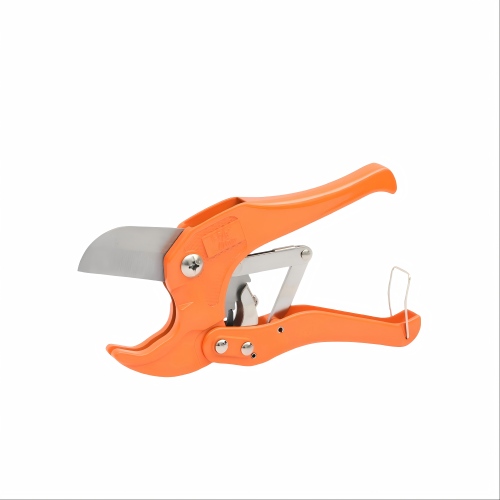
Plastic/Vinyl Pipe Cutter 42mm/1.6 Inch
Plastic/Vinyl Pipe Cutter 42mm/1.6 Inch Cutting Heavy Duty Pipe and Tube Cutter 1-5/8inch/42mm Tool for PVC CPVC PEX PE PPR
★ Made of aluminum alloy and 2.5mm thick steel blade with precision-ground cutting edge.
★ With perfect ratchet drive technology, and faultless blade. Labor saving and provide fast and perfect cutting.
★ Ideal for smoother cuts for PVC CPVC PEX PE PPR hose, and most non-metallic tubes.
★ Easily replaceable blade, and suit for 1-5/8"/45mm OD tubing.
Order Information & Inquiry Options
Choose whichever channel fits your buying process — we reply to all three within 12 hours, Monday to Saturday.
WhatsApp: +86 15867457689 — Amy
Email: amy@longrunhardware.com — for formal RFQ with target spec, quantity, destination port, and Incoterms (FOB Ningbo / CIF / DDP)
RFQ form: Request a Quote online — structured form, 15 fields, takes ~3 minutes
For OEM / private-label programs, please include your target spec, color, logo file (AI / PDF / PNG), retail box design, quantity, and destination port. Our export team will confirm specification, sample plan, lead time, and FOB / CIF pricing.
About the Author
Alisa Xu | Product Manager | Ningbo Torchmark Hardware Co., Ltd.
0086-13429254575 | Alisa Xu on LinkedIn
What This 42 mm Ratchet Shear Is Actually Built to Cut
A "42 mm pipe cutter" is a capacity rating, not a promise about every tube that measures 42 mm. Before you place a wholesale order, it helps to separate three things: the outside diameter ceiling, the wall thickness, and the material. This model is a ratchet-action shear with an aluminium alloy body and a 2.5 mm thick precision-ground steel blade, rated for 1-5/8 in (42 mm) and used across PVC, CPVC, PEX, PE and PPR. It cuts non-metallic tube only.
The three limits that decide whether a cut is clean
Diameter. The jaw must close past the tube. Most 42 mm shears will bite a tube up to roughly 45 mm outside diameter when the wall is thin.
Wall thickness. A thick-wall PPR pipe at 42 mm can be harder to cut than a thin-wall PVC pipe at 50 mm. Wall thickness, not diameter, is what loads the blade.
Material hardness. Soft thermoplastics shear cleanly; glass-filled or mineral-filled compounds blunt a ground edge quickly.
Why the phrase "non-metallic tubes" matters in a spec sheet
If your catalogue lists this tool next to copper or stainless tube cutters, expect returns. The blade geometry of a plastic shear is a slicing edge; a copper tubing cutter uses a rolling wheel that work-hardens and separates metal. Using one for the other produces a ragged, oval mouth that will not seat properly in a fitting.
Material by Material: What Cuts Clean and What Does Not
These are the materials our export team sees specified most often for this capacity class, and what actually happens at the bench.
| Material | Typical use | Cut quality at 42 mm | What to watch |
|---|---|---|---|
| PVC (schedule 40 / 80) | Cold water, drainage, conduit | Clean, square, minimal burr | Schedule 80 wall needs a slower ratchet stroke |
| CPVC | Hot water lines | Clean; slightly more resistance than PVC | Brittle in cold rooms — warm the pipe before cutting |
| PEX / PE-RT | Radiant heating, flexible runs | Clean, but the tube can ovalise | Support the tube with a second hand to stop flattening |
| PE / LDPE | Irrigation, pond, cable duct | Very easy cut | Soft wall can pinch; do not over-tighten the ratchet |
| PPR (PN20 / PN25) | Hot and cold pressurised water | Cuts, but wall is thick — expect a firm stroke | If PPR is your main volume, compare the 42 mm PVC PPR pipe cutter |
| ABS | Waste and vent | Clean | Produces more dust than PVC; cut in a ventilated area |
Where buyers get caught out
The most common complaint we field is not "the blade is dull" but "the pipe shattered". In almost every case the pipe was CPVC or aged PVC cut in an unheated warehouse. The fix is process, not tooling: store the pipe above 5 °C for 24 hours before cutting.
Blade Specification: Why 2.5 mm Thickness Matters
A replacement blade is the cheapest part of this tool and the part buyers most often under-specify. Thickness governs two things: how much the blade deflects under load, and how many resharpenings it survives.
What 2.5 mm buys you in practice
Less blade wander. A thinner blade flexes away from the cut line on thick-wall PPR, leaving a bevelled mouth that leaks at the fitting.
Longer service life. A 2.5 mm ground edge can be resharpened several times before it drops below the jaw line.
Predictable spare-part sales. For distributors, a replaceable blade is a repeat-order line. Stocking blades alongside the tool is normal in this category.
Blade steel and surface treatment options
Our standard blade for this capacity is high-carbon steel with a ground edge. Two surface treatments are available depending on your market: heat treatment only, or heat treatment with a Teflon coating that reduces friction on PPR and ABS. If you want to specify one on your purchase order, see the 42 mm automatic PVC pipe cutter OEM page, which lists the blade options line by line.
Ratchet Drive: How the Mechanism Reduces Effort
A ratchet shear converts several small squeezes into one deep cut. That matters in two situations your customers will actually notice: overhead work, and repetitive cutting on a job site where the same installer cuts fifty pipes a day.
Why the ratchet stroke changes the cut quality
Each ratchet step advances the blade a few millimetres and holds position. Because the blade does not spring back, the operator controls the feed rate instead of fighting it. On thin-wall PEX this prevents the crush failure you get with a single-stroke cutter.
Maintenance that keeps the ratchet working
Blow out plastic dust from the ratchet teeth after heavy use — packed dust makes the pawl skip.
Oil the pivot pin lightly; do not use grease, which holds dust.
Replace the blade before it stops slicing and starts tearing. A torn cut is a fitting leak waiting to happen.
Capacity and the 42 mm vs 45 mm Question
Product titles in this category are inconsistent across the market. You will see the same physical tool listed as 42 mm, 1-5/8 in, and 45 mm OD. The honest answer is that 42 mm is the nominal rating and thin-wall tube up to about 45 mm outside diameter will still fit the jaw.
How to write the capacity on your own packaging
We recommend stating the nominal rating and the material range together, for example "42 mm (1-5/8 in) — PVC / CPVC / PEX / PE / PPR". A single number without a material list generates questions and, eventually, returns.
When 42 mm is the wrong size
If your customers routinely cut 50 mm or 63 mm pipe, sell them the larger tool rather than the larger promise. The 63 mm ratchet PVC pipe cutter covers the upper range, and the 63 mm model on this site carries the full carton data.
Blade Replacement and Total Cost of Ownership
For a distributor, the blade is a margin line. For an end user, it is the difference between a tool that lasts three years and one that is thrown away in six months.
What to stock alongside the tool
Replacement blades in the same steel and treatment as the fitted blade.
The pivot pin and spring, which are the parts most often lost on site.
Retail packaging that names the compatible capacity, so the buyer reorders the right blade.
Why a replaceable blade beats a sealed cutter here
Sealed cutters are cheaper to buy and impossible to service. In markets where labour is cheap and tools are expensive, a replaceable blade wins. In markets where the reverse is true, a sealed cutter may sell better. Tell us which market you supply and we will quote both.
Packaging, Labelling and Carton Data
The standard retail pack for this model is a single blister with a colour card. Double blister is available if your channel requires a heavier shelf presence.
What we need from you to quote packaging
Blister or double blister, and whether you supply print-ready artwork.
Barcode format and numbering.
Carton quantity target and any retailer height or weight limits.
Destination port and Incoterms (FOB Ningbo, CIF or DDP).
Who Buys This Model and in What Quantities
This capacity is the default in two channels: plumbing wholesale, where it sits next to solvent cement and fittings, and irrigation supply, where PE and LDPE dominate. Buyers usually start with a mixed carton rather than a single-SKU order.
Sampling before you commit
We ship paid samples so you can test blade life on your own pipe stock before a container order. A sample order normally includes the tool, one spare blade, and the retail pack you intend to sell.
Frequently Asked Questions
Will it cut PPR as well as PVC?
Yes, but PPR has a thicker wall at the same nominal diameter, so the stroke is firmer. If PPR is the majority of your volume, look at the PPR-specific model as well and compare them side by side.
Is 42 mm the true maximum?
42 mm is the nominal rating. Thin-wall tube up to roughly 45 mm outside diameter will fit the jaw. Thick-wall tube should stay within 42 mm.
Can the blade be replaced or resharpened?
Both. The blade is a replaceable part, and the 2.5 mm ground edge can be resharpened several times before it falls below the jaw line.
What blade surface treatment should I specify?
Heat treatment is standard. Add Teflon if your customers cut a lot of PPR or ABS, where friction and dust build up on the blade face.
Is this suitable for copper tube?
No. This is a non-metallic shear. For copper, use a wheel-type tubing cutter such as the 168 mm large tubing cutter.
What is the standard retail pack?
Single blister with a colour card. Double blister is available, and we can print your artwork and barcode.
Next Step
Send the capacity, material range, blade treatment, packaging and quantity you need and we will come back with specification, sample plan, lead time and FOB or CIF pricing. For a structured RFQ use the form on this page; for a direct conversation email amy@longrunhardware.com, alisa@longrunhardware.com. Related reading: the PVC and PPR tool buying guide and the PVC and PPR pipe tool range.
Related Buying Guides
Building a plastic pipe tooling line? These guides cover sizing standards and B2B sourcing basics.
Questions buyers ask about PVC pipe cutters
What is the difference between a ratcheting and a scissor-style PVC cutter?
A scissor cutter is light and fast for small-diameter, low-wall pipe you cut all day; a ratcheting cutter multiplies your force for larger or thicker-wall PVC and CPVC with less hand fatigue. Choose by the largest diameter you regularly cut.
What is the maximum diameter a PVC pipe cutter handles?
Scissor cutters typically cover up to about 42 mm (1-1/4 in); ratcheting models reach 50-63 mm (2-2-1/2 in) and heavy models a bit more. Cutting beyond rated capacity damages the blade and leaves a ragged edge.
How do I get a square, burr-free cut?
Mark a square line, keep the cutter square to the pipe, and close in steady strokes rather than twisting. A light pass with a deburring tool on the inside edge removes the lip that restricts flow and snags fittings.
When should I replace the blade?
Replace when cuts need more force, start to crush rather than slice, or leave a ragged or angled edge. A sharp blade cuts cleaner and puts less stress on the joint; keep a spare blade in the kit.
Can the same cutter be used on PEX or CPVC?
CPVC cuts like PVC with the same tool. PEX is better cut with a dedicated PEX/scissor cutter or a tubing shears to avoid distorting the bore; a PVC ratchet can pinch PEX out of round.
single blister with color card
double blister