

Heavy-Duty Cr-V Tube Flaring Tool
Heavy-Duty Cr-V Tube Flaring Tool: The Reliable Choice for Global Distributors
For hardware wholesalers supplying the HVAC, refrigeration, and automotive industries, providing a reliable flaring tool is non-negotiable. An inaccurate flare leads to refrigerant leaks, unhappy contractors, and high retail return rates.
At Longrun Hardware, we engineer our manual tube flaring tools to eliminate these field failures. By upgrading our core materials and offering flexible, retail-ready packaging, we provide B2B distributors with a high-margin, shelf-ready product that professionals trust.
[Insert CTA Button: Request Wholesale Pricing & OEM Catalog]
1. Technical Precision: The Cr-V Steel Advantage
The biggest complaint end-users have with generic flaring tools is structural weakness. Under high torque, cheap cast-iron yokes crack, and low-grade die blocks score the copper tubing.
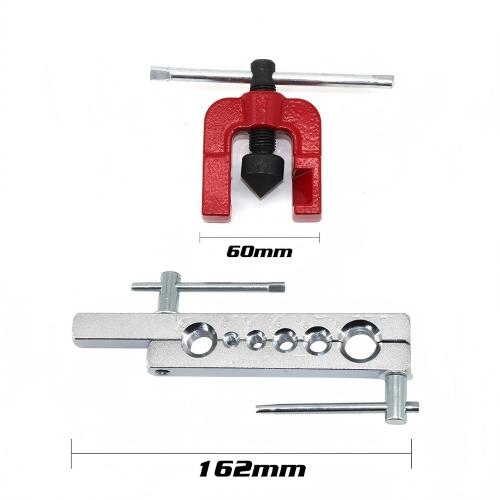
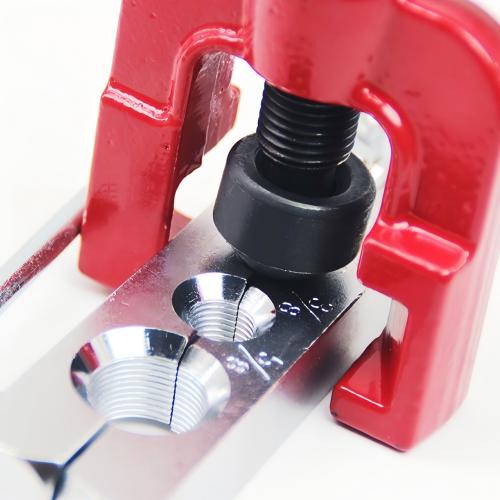
We solve this at the metallurgical level. Our 60mm flaring frames and 162mm die sets are forged from Chromium-Vanadium (Cr-V) Steel.
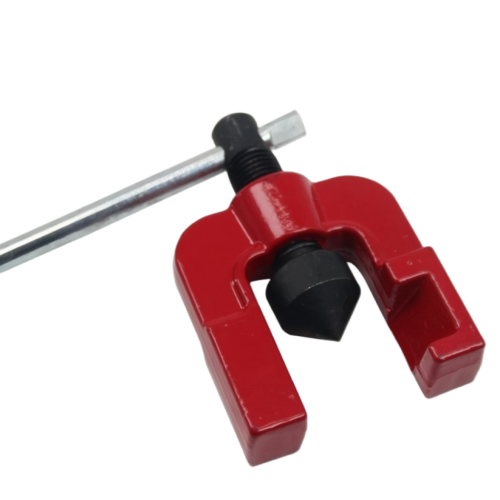
Zero Deflection: The Cr-V construction ensures the yoke maintains its rigidity, driving the concentric cone perfectly straight into the tube for a flawless 45-degree seal.
Smooth Tube Grip: The Cr-V die block clamps securely without leaving deep, weak-point gouges on thin-walled copper or aluminum piping.
Commercial Value: Supplying Cr-V grade tools drastically reduces your defective return rates, protecting your brand reputation and profit margins.
2. Industry Applications: Bridging the Metric & Imperial Gap
Tubing standards vary drastically across the globe. European and Asian HVAC markets rely heavily on metric sizing, while North American plumbing and automotive sectors demand imperial measurements.
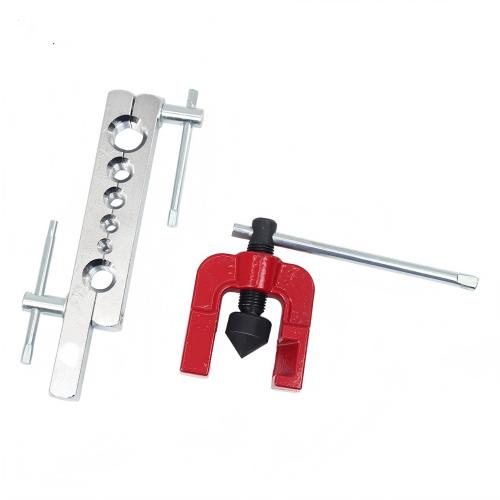
Instead of dealing with multiple suppliers, Longrun Hardware offers interchangeable die sets to cover your entire global footprint:
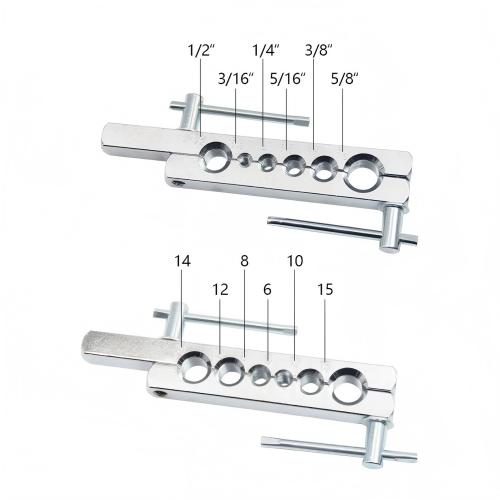
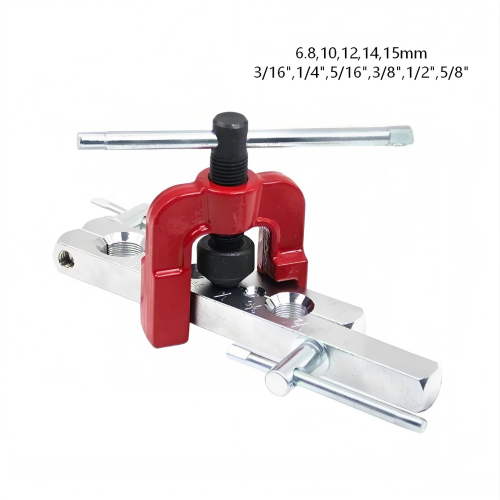
Metric Die Block: 6mm, 8mm, 10mm, 12mm, 14mm, and 15mm.
Imperial Die Block: 3/16", 1/4", 5/16", 3/8", 1/2", and 5/8".
Custom Hole Development: Does your specific regional market use a non-standard tube diameter? Our engineering team can machine custom die hole sizes exclusively for your wholesale orders.
3. Strict Quality Control (QC) Process
Your brand name is on the line with every tool you sell. As a direct manufacturer, we implement rigorous QC checkpoints before any batch is cleared for export:
Material Hardness Testing: Verifying the tensile strength of the Cr-V steel to ensure it meets industrial torque standards.
Thread & Alignment Inspection: The central drive screw and flaring cone are laser-checked for dead-center alignment with the die block holes.
Visual Packaging Audits: Ensuring every sliding card or blister pack is perfectly sealed for pristine retail presentation.
4. Retail-Ready Packaging & OEM Customization
We don't just manufacture tools; we help you sell them. Whether you supply independent hardware stores or large DIY supermarket chains, we offer packaging solutions designed for maximum point-of-sale impact.
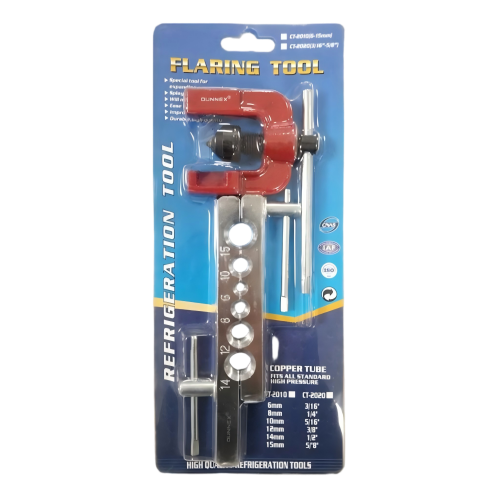
Retail Display Packaging: Choose between cost-effective Sliding Cards or high-security Double Blister Packs, perfect for hanging on retail pegboards.
Full Brand Integration: We offer comprehensive OEM services. Your corporate logo can be permanently engraved on the tool frame, printed on the full-color retail cards, and stamped on the heavy-duty master cartons.
Scalable Configurations: You decide the final product presentation. Order the frame and die set combined, or request specific metric/imperial blocks based on your inventory needs.
Secure your supply chain with a factory that understands B2B retail standards.
Contact Us for OEM Branding & Bulk MOQs
Technical Specifications at a Glance
Product Name: Tube Flaring Tool
Core Material: Chromium-Vanadium (Cr-V) Steel
Dimensions: Frame Height: 60mm | Die Set Length: 162mm
Die Hole Sizes (Metric): 6mm, 8mm, 10mm, 12mm, 14mm, 15mm
Die Hole Sizes (Imperial): 3/16", 1/4", 5/16", 3/8", 1/2", 5/8"
(Note: Custom hole sizes available upon request)
Included Components: 1x Cr-V Frame + 1x Die Set (Metric or Imperial optional)
Packaging Options: Sliding Card / Double Blister Pack
Order Information & Inquiry Options
Choose whichever channel fits your buying process — we reply to all three within 12 hours, Monday to Saturday.
WhatsApp: +86 15867457689 — Amy
Email: amy@longrunhardware.com — for formal RFQ with target spec, quantity, destination port, and Incoterms (FOB Ningbo / CIF / DDP)
RFQ form: Request a Quote online — structured form, 15 fields, takes ~3 minutes
For OEM / private-label programs, please include your target spec, color, logo file (AI / PDF / PNG), retail box design, quantity, and destination port. Our export team will confirm specification, sample plan, lead time, and FOB / CIF pricing.
About the Author
Alisa Xu | Product Manager | Ningbo Torchmark Hardware Co., Ltd.
0086-13429254575 | Alisa Xu on LinkedIn
What Cr-V steel actually buys you
Chromium-vanadium is printed on a lot of tooling. It is worth knowing what it changes and what it does not, because the answer decides whether the higher cost is justified.
Vanadium refines the grain
The addition of vanadium gives a finer grain structure, which raises toughness rather than just hardness. That is the property that matters in a tool loaded in bending.
Hardness without brittleness
A flaring cone has to be hard enough to form tube without wearing, and tough enough not to chip when it is driven. Chromium-vanadium reaches both where plain carbon steel trades one for the other.
Why it matters specifically on a flaring tool
The cone and the yoke carry the forming load. A cone that wears loses its finish, and a scored cone marks every flare it makes from then on.
What it does not do
It does not make a badly machined cone accurate, and it does not compensate for a worn clamping bar. Material is one input to a flare, not the whole result.
Covering metric and inch tube in one tool
A distributor selling into more than one market needs a tool that handles both systems. That requirement drives most of the specification.
| System | Common sizes | Typical market |
| Metric | 6, 8, 10, 12, 15, 16, 18, 19 mm | Europe, Asia, most OEM service data |
| SAE | 1/4, 5/16, 3/8, 1/2, 5/8, 3/4 in | North America, older installations |
| Overlap | 6.35, 9.53, 12.70, 15.88, 19.05 mm | Where a metric bore is close but not identical |
A metric bar will not clamp an inch tube properly
Bores are machined to one system. Putting 1/2 inch tube in a 12 mm bore leaves clearance, and the tube pushes down when the cone enters.
Close is not the same as correct
Several sizes sit within a few tenths of a millimetre of each other across systems. That near-match is exactly what produces a flare that clamps but slips.
Confirm which bars ship
Ask whether both bars are included or whether the buyer chooses one. A listing that says metric and SAE without saying both bars is the most common source of a wrong order.
What a flare needs before the tool matters
Most flare failures are preparation failures. Three steps decide the result before the cone moves.
Cut square
An angled cut produces an angled flare that seats unevenly on the fitting. A square cut is the cheapest quality control step in the whole job.
Deburr the bore
The burr left by the cut holds debris and can score the fitting cone. Removing it takes seconds and prevents the leak that costs a callout.
Stop the tube sliding in the bar
If the bar does not grip, the tube pushes down as the cone enters and the flare forms short. Tighten evenly and set the tube flush with the bar face.
Drive to a repeatable depth
Depth decides whether the flare seats or bottoms out. A stop or a marked depth gives repeatable flares that judging by eye does not.
Where a heavy-duty flaring tool is the wrong buy
Two markets buy this tool, and it is wrong for a third.
HVAC and refrigeration
Soft copper takes a single 45-degree flare. This is the core application and the reason most distributors stock the tool.
Automotive brake and fuel line
Steel tube needs a double or inverted flare. Confirm the folding adapter is present, because without it the tool forms single flares only.
Hydraulic work at 37 degrees
JIC and AN fittings use 37 degrees. A 45-degree tool produces a flare that looks right and does not seal, which is the wrong tool entirely.
Hard and thick-wall tube
The tool is specified for soft copper, aluminium, brass and thin-wall steel. Anything outside that list needs bench tooling with more clamping force.
What to check on a sample before a volume order
Four checks cover what fails in a workshop.
Form a flare in every bore
Work through each size on scrap tube of the matching system. A bore that nominally exists but will not clamp is the defect to find on a sample.
Section one flare
Cut a formed flare lengthways. The wall should be even and not thinned to a knife edge at the cone.
Look at the cone finish
The working face should be smooth. A scored or roughly finished cone marks every flare it forms from that point on.
Seat it on a real fitting
Thread the matching nut on and tighten it. The flare should sit fully on the fitting cone rather than bottoming out early.
Questions buyers ask about the Cr-V flaring tool
What does Cr-V mean compared with carbon steel?
Chromium-vanadium gives a finer grain, so the steel is tough as well as hard. On a flaring cone that means it resists chipping and keeps its finish longer.
Does it cover both metric and inch tube?
Only if both bars ship. Confirm that on the quotation, because a metric bar will not clamp an inch tube properly even where the sizes look close.
Can it do double flares for brake line?
Only with the folding adapter included. Without it the tool forms single 45-degree flares, which is not what steel brake tube requires.
Is it suitable for hydraulic fittings?
No. JIC and AN fittings use a 37-degree flare, and a 45-degree tool produces a flare that looks right and does not seal.
Which tube materials can it form?
Soft copper, aluminium, brass and thin-wall steel as specified. Hard, thick-wall or stainless tube needs bench tooling.
Can we add our brand and packaging?
Logo, case colour and retail artwork are OEM options quoted against the configuration. Raise it at the enquiry because artwork approval affects the lead time.
Request a quotation for the heavy-duty flaring tool
Send the sizes to be covered, inch or metric or both, the flare types required, quantity and destination, and we will return a configuration list and a quotation. Email amy@longrunhardware.com, alisa@longrunhardware.com, or message us on WhatsApp at +86 158 6745 7689. Product Manager Alisa Xu handles this range. Eccentric tooling is on the FT-806AM-F page, fixed-bar sets on the 7-hole page and the 8-piece page, brake line kits on the complete brake line kit page and the 34-piece page, and the full range sits under tube flaring tool kits. Flare geometry is explained in the leak-free HVAC flare guide, sizing pitfalls in the inch versus metric guide, and OEM terms are on the OEM process page.
Related Buying Guides
Specifying flaring tools for HVAC or brake line work? These guides explain flaring types, common field mistakes and metric/SAE sizing.
Questions buyers ask about flaring tool kits
What is the difference between a 45-degree and a 37-degree flare?
A 45-degree flare is the standard for plumbing, LPG and general tube work; a 37-degree (JIC/AN) flare is used for hydraulic, fuel and higher-pressure lines. Mixing the two leaks, so match the flare angle to the fitting you connect to, not to the tool you happen to own.
When should I use a double flare instead of a single flare?
Use a double flare on soft copper and aluminum brake or fuel lines where vibration and pressure can crack a single flare. A single flare is enough for stationary plumbing and HVAC connections that are torqued once and left alone.
Which flare is required for R410A HVAC connections?
R410A systems run at higher pressure, so a clean 45-degree single flare on annealed copper with proper flare-nut torque is standard; many techs prefer flared joints over compression for these pressures. Always use a proper flaring block and avoid nicks on the tube mouth.
How do I prevent leaks at a flare joint?
Cut the tube square, ream the inside, flare without cracks, and seat the flare nut with a calibrated torque rather than by feel. A tiny dab of refrigerant-compatible oil on the seat helps; never use pipe dope on a flare face. Inspect the cone for cracks before assembly.
What sizes do flaring tools cover, metric and imperial?
Most kits cover the common range: 1/4, 5/16, 3/8, 1/2, 5/8 and 3/4 in, plus 4, 6, 8, 10 and 12 mm. Confirm the mandrel set matches the tubing you stock so you are not one size short on a job.
How do I avoid cracking copper when flaring?
Use annealed (soft) copper, support the tube in the correct-size clamp without over-tightening, and rotate the yoke evenly. Work the mandrel in smoothly rather than forcing it; a cracked flare wastes the tube and risks a leak.
Retail-Ready Packaging & OEM Customization
We don't just manufacture tools; we help you sell them. Whether you supply independent hardware stores or large DIY supermarket chains, we offer packaging solutions designed for maximum point-of-sale impact.
Retail Display Packaging: Choose between cost-effective Sliding Cards or high-security Double Blister Packs, perfect for hanging on retail pegboards.
Full Brand Integration: We offer comprehensive OEM services. Your corporate logo can be permanently engraved on the tool frame, printed on the full-color retail cards, and stamped on the heavy-duty master cartons.
Scalable Configurations: You decide the final product presentation. Order the frame and die set combined, or request specific metric/imperial blocks based on your inventory needs.
Secure your supply chain with a factory that understands B2B retail standards.
Contact Us for OEM Branding & Bulk MOQs
Technical Specifications at a Glance
Product Name: Tube Flaring Tool
Core Material: Chromium-Vanadium (Cr-V) Steel
Dimensions: Frame Height: 60mm | Die Set Length: 162mm
Die Hole Sizes (Metric): 6mm, 8mm, 10mm, 12mm, 14mm, 15mm
Die Hole Sizes (Imperial): 3/16", 1/4", 5/16", 3/8", 1/2", 5/8"
(Note: Custom hole sizes available upon request)
Included Components: 1x Cr-V Frame + 1x Die Set (Metric or Imperial optional)
Packaging Options: Sliding Card / Double Blister Pack