


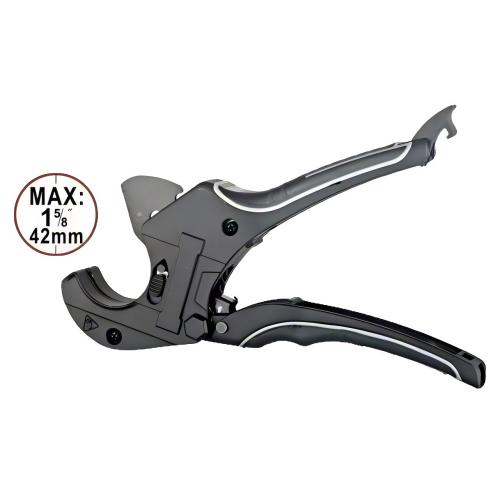
42mm Automatic Plastic Pipe Cutter
Automatic Pipe Cutter/Plumbing Tool
Cutting dia.: 42mm
Material: Aluminium Alloy
Blade: Stainless Iron or High Carbon Steel
Surface Treatment for the Blade: Teflon for High Carton Steel
Advantage: Blade is easily to be changed.
Features
Ratchet Shears are ideal for cutting PE, PEX, PP and ABS pipe and tubing.
Smoothest ratchet action for easiest cuts.
Replace or resharpen blades for longer tool life and faster cuts.
Order Information & Inquiry Options
Contact our team with your required specification, order quantity and destination.
WhatsApp: +86 15867457689 — Amy
Email: amy@longrunhardware.com — for formal RFQ with target spec, quantity, destination port, and Incoterms (FOB Ningbo / CIF / DDP)
RFQ form: Request a Quote online — structured form, 15 fields, takes ~3 minutes
For OEM / private-label programs, please include your target spec, color, logo file (AI / PDF / PNG), retail box design, quantity, and destination port. Our export team will confirm specification, sample plan, lead time, and FOB / CIF pricing.
About the Author
Alisa Xu | Product Manager | Ningbo Torchmark Hardware Co., Ltd.
0086-13429254575 | Alisa Xu on LinkedIn
What "Automatic" Means on a Ratchet Pipe Cutter
In this category "automatic" does not mean powered. It describes the ratchet mechanism: a pawl-and-tooth drive that advances the blade in small steps and holds position between squeezes. You release, the jaw reopens, the blade stays where it is. That single behaviour is what separates this tool from a plain single-stroke shear.
The three things the ratchet changes
Effort per stroke. Several light squeezes replace one hard crush. On 42 mm pipe the difference is significant for anyone cutting overhead.
Control of feed rate. Because the blade holds position, the operator decides how fast it advances. Slow feed is what keeps a cut square.
Consistency across operators. A lighter, slower stroke produces a more repeatable cut regardless of hand strength.
What it does not change
The ratchet does not increase capacity, and it does not make a blunt blade cut. A 42 mm automatic cutter is still a 42 mm cutter, and blade condition still governs cut quality.
Inside the Mechanism: Pawl, Teeth and Return Spring
Understanding the three wearing parts helps a distributor answer the two questions customers actually ask: why does it skip, and can it be serviced.
| Part | What it does | Common fault | Fix |
|---|---|---|---|
| Drive pawl | Engages the ratchet teeth and advances the blade | Skips under load | Clear packed dust from the teeth; check spring tension |
| Ratchet teeth | Hold the blade position between squeezes | Worn or chipped after heavy use | Replace the handle assembly |
| Return spring | Reopens the jaw after each squeeze | Jaw does not reopen fully | Replace spring; do not stretch the old one |
| Blade | Does the cutting | Tears instead of slicing | Replace or resharpen |
Why dust is the usual culprit
Plastic cutting produces fine swarf that packs into the ratchet teeth. The symptom is a handle that squeezes without advancing. In most cases the tool is not broken; it needs the teeth blown out. This is worth putting on the retail card, because it prevents avoidable warranty returns.
Lubrication guidance
Oil the pivot pin lightly. Do not use grease — it holds dust and makes the packing problem worse.
Blade Options and Why They Are Easy to Change
Blade replacement is a design feature on this model, not an afterthought. The blade is retained so it can be swapped without tools in most configurations.
Blade steel choices
High-carbon steel. Holds the sharpest edge longest. Standard for indoor PVC and PEX work.
Stainless iron. Slightly shorter edge life, better corrosion resistance for humid or coastal markets.
Surface treatment
Heat treatment is standard on both. Add Teflon if your customers cut PPR or ABS, where friction and swarf build up on the blade face. If you are specifying blades for an own-brand programme, the options are set out line by line on the 42 mm automatic PVC pipe cutter OEM page.
Materials: What the Ratchet Shear Handles Best
Ratchet shears are specified for PE, PEX, PP and ABS pipe and tubing. That list is deliberate — these are the materials where a controlled, slow feed produces a noticeably better cut than a single-stroke tool.
Why controlled feed helps flexible materials
PEX and PE are soft enough to flatten under a fast, hard squeeze. The ratchet lets the operator advance gently and keep the tube round. That matters because an oval pipe will not seat properly in a compression or crimp fitting.
ABS and the dust question
ABS cuts cleanly but generates more dust than PVC. In enclosed spaces, cut with ventilation. The dust is also the main reason the ratchet teeth need periodic cleaning.
Materials that are out of scope
This is a plastic shear. Metal tube requires a wheel-type cutter — see the 168 mm large tubing cutter for copper and other metal pipe.
Maintenance Schedule That Extends Tool Life
Professional users get years out of this tool with three habits. Worth printing on the packaging if your channel is trade-facing.
After each day of heavy use
Blow or brush plastic swarf out of the ratchet teeth.
Wipe the blade and coat it lightly with oil if the tool will be stored damp.
Check the jaw opens fully under the return spring.
Blade replacement timing
Replace or resharpen at the first sign of tearing rather than waiting for the blade to stop cutting. A tearing blade produces a bevelled mouth, which becomes a leaking joint downstream.
Packaging Options
Single blister is the most popular configuration for this model and suits a standard peg hook. Double blister is also accepted where a heavier shelf presence or more multilingual text is needed.
What we need to quote packaging
Single or double blister, and whether you supply print-ready artwork.
Barcode format and numbering.
Carton quantity target and any retailer limits.
Destination port and Incoterms — FOB Ningbo, CIF or DDP.
Frequently Asked Questions
Is "automatic" powered?
No. It refers to the ratchet drive that advances the blade in steps and holds position between squeezes. No batteries or motor are involved.
Why does the handle squeeze without cutting?
Almost always packed plastic dust in the ratchet teeth. Clean the teeth and check the pawl spring before assuming a fault.
Can the blade be resharpened?
Yes. The blade is replaceable, and the ground edge can be resharpened several times before it drops below the jaw line.
Will it cut PEX without flattening the tube?
Yes, provided you advance the ratchet gently. That controlled feed is exactly what the mechanism is for.
Single or double blister?
Single blister is the most popular and suits standard peg hooks. Double blister is available where you need more print area or shelf presence.
Is it suitable for metal pipe?
No. Use a wheel-type tubing cutter for copper or stainless.
Next Step
Send your capacity, material range, blade specification, packaging and quantity. Our export team will confirm specification, sample plan, lead time and FOB or CIF pricing. Email amy@longrunhardware.com, alisa@longrunhardware.com. See also the 42 mm PVC PPR pipe cutter for pressurised pipe work, and the PVC and PPR pipe tool range.
Related Buying Guides
Building a plastic pipe tooling line? These guides cover sizing standards and B2B sourcing basics.
Questions buyers ask about PVC pipe cutters
What is the difference between a ratcheting and a scissor-style PVC cutter?
A scissor cutter is light and fast for small-diameter, low-wall pipe you cut all day; a ratcheting cutter multiplies your force for larger or thicker-wall PVC and CPVC with less hand fatigue. Choose by the largest diameter you regularly cut.
What is the maximum diameter a PVC pipe cutter handles?
Scissor cutters typically cover up to about 42 mm (1-1/4 in); ratcheting models reach 50-63 mm (2-2-1/2 in) and heavy models a bit more. Cutting beyond rated capacity damages the blade and leaves a ragged edge.
How do I get a square, burr-free cut?
Mark a square line, keep the cutter square to the pipe, and close in steady strokes rather than twisting. A light pass with a deburring tool on the inside edge removes the lip that restricts flow and snags fittings.
When should I replace the blade?
Replace when cuts need more force, start to crush rather than slice, or leave a ragged or angled edge. A sharp blade cuts cleaner and puts less stress on the joint; keep a spare blade in the kit.
Can the same cutter be used on PEX or CPVC?
CPVC cuts like PVC with the same tool. PEX is better cut with a dedicated PEX/scissor cutter or a tubing shears to avoid distorting the bore; a PVC ratchet can pinch PEX out of round.
Single blister is most popular
Double blister is also accepted