


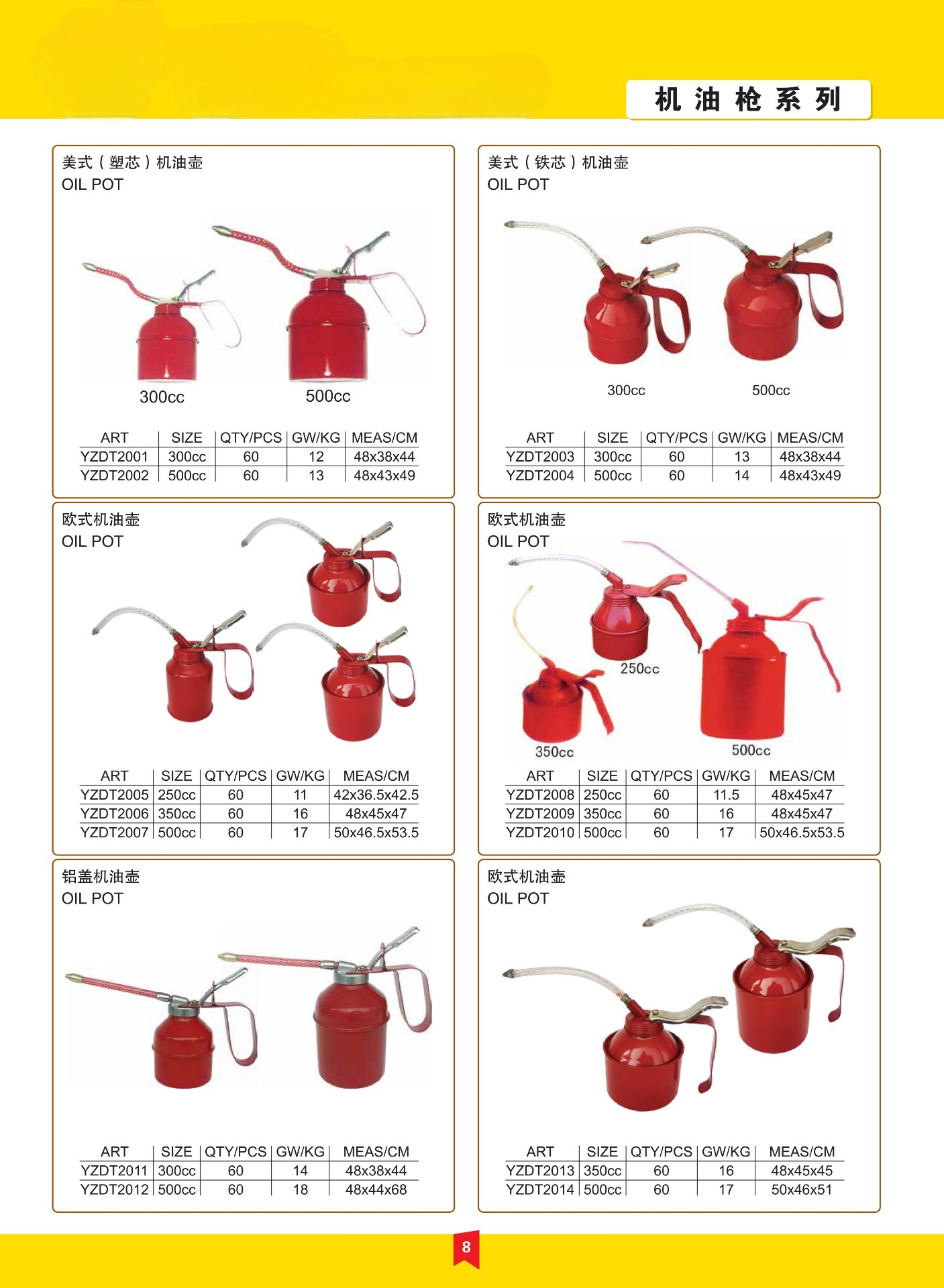
YZDT2001 American Pressurised Oil Pot 300cc
American-Style Pressurized Oil Pot (YZDT2001) — 300cc Oil Pot with Plastic Pump Core
The YZDT2001 is the iconic American-style 300cc pressurized oil pot for workshops, auto service shops, and small-engine repair. A powder-coated steel tank with a replaceable plastic pump core delivers a steady, controllable stream — perfect for daily lubrication of bearings, hinges, and chains.
| SKU | YZDT2001 |
|---|---|
| Type | Powder-coated steel tank + plastic pump core (塑芯) |
| Capacity | 300cc |
| Net / Gross Weight | Net ~0.20 kg / Gross 12 kg per 60-ctn |
| Spout | Rigid bent spout with control valve |
| Application | Auto service, small engine repair, agricultural equipment, light industrial maintenance |
Key Features
American-style ergonomic pistol grip
Replaceable plastic pump core for long service life
Steady pressurized stream for precise lubrication
Leak-proof threaded cap and valve assembly
OEM & Bulk Supply
Available for pressurized oil pot wholesale and OEM oil pot China programs: MOQ from 500 pcs for stock configurations, 1,000–3,000 pcs for custom logo, color, and packaging; full container (FCL) orders welcome. Lead time 30–45 days for production. Payment: 30% T/T deposit + 70% against B/L, or 100% T/T for small orders. Each unit passes AQL 2.5 inspection (ISO 2859-1) and complies with RoHS / REACH.
Related buyer's guide: Oil Gun vs Oil Can: How to Choose the Right Lubrication Tool — capacity, spout, and material comparison for workshops and distributors.
Request a quote / private-label proposal
Custom Logo, Cards & Color for Oil Cans
TORCHMARK / Longrun Hardware supports B2B OEM and private-label programs for oil cans and lubrication tools. Available customization:
Custom logo: print your brand logo on the can body or lid for private-label programs.
Logo cards & hanging cards: we can supply retail display cards or hanging cards (৵卡) with your logo and barcode for shelf presentation.
Color customization: for large-quantity orders we can produce custom body colors to match your brand.
Packaging & OEM: export cartons, barcodes and private-label artwork per confirmed program.
Send your target model (SL-203 / SL-210 / YZDT2001 / YZDT2021), quantity, color and packaging format to confirm specification, sample plan and lead time.
Order Information & Inquiry Options
Contact our team with your required specification, order quantity and destination.
WhatsApp: +86 15867457689 — Amy
Email: amy@longrunhardware.com — for formal RFQ with target spec, quantity, destination port, and Incoterms (FOB Ningbo / CIF / DDP)
RFQ form: Request a Quote online — structured form, 15 fields, takes ~3 minutes
For OEM / private-label programs, please include your target spec, color, logo file (AI / PDF / PNG), retail box design, quantity, and destination port. Our export team will confirm specification, sample plan, lead time, and FOB / CIF pricing.
About the Author
Alisa Xu | Product Manager | Ningbo Torchmark Hardware Co., Ltd.
0086-13429254575 | Alisa Xu on LinkedIn
300 cc or 350 cc: choosing the right pressurised oil pot
The YZDT2001 is the American-style 300 cc pot: powder-coated steel tank, plastic pump core, rigid bent spout with a control valve, packed 60 to a carton at 12 kg gross. Buyers comparing it against the 350 cc YZDT2021 and against the smaller 250 g CJ-037 usually ask which one to stock first. The answer depends less on capacity than on who is holding the tool and what they are lubricating.
What capacity actually decides
Capacity sets how long a technician works between refills, and that is an economic question rather than a technical one. In a service bay where a technician oils hinges, latches and linkages through a shift, 300 cc is roughly a working day's use and the pot gets refilled at the bench. On a production line where the pot is used continuously against conveyor bearings, the refill interruption costs more than the extra oil, which is why the larger and heavier 350 cc version exists. Below that, the 250 g CJ-037 is a compact issue tool for a toolbag or a machine-side kit.
American-style pistol grip against a European pump
The American pattern holds the tank in the palm with the index finger operating the pump, so the spout points where the hand points. Technicians trained on it will not accept a European-style can with a top-mounted pump, because the grip changes the angle at which the spout reaches a fitting. Style is not cosmetic in this category: it is the reason a buyer's existing fleet locks them into one pattern.
The pump core is the service part, not the tank
The tank on a pressurised pot rarely fails. The pump core, the valve and the spout seal do, because they are what moves and what contacts oil. A replaceable plastic pump core turns the pot into a serviceable tool: the distributor sells a core instead of a new pot, and the customer keeps a tool they trust. When you quote this range, quote the pump core as a separate line item and confirm that spares will be available for the model you stock. A pot with a sealed, non-replaceable pump is a one-sale item.
Comparing the four lubrication formats in the range
Values below follow the listed catalogue configurations for each model. Confirm the packing list for the configuration you order, since carton counts differ between models and change the freight calculation.
| Model | Format | Capacity | Packing reference | Typical buyer |
|---|---|---|---|---|
| YZDT2001 | Steel tank, plastic pump core, rigid bent spout with valve | 300 cc | 60 pcs per carton, 12 kg gross | Auto service, small engine repair, agricultural equipment |
| YZDT2021 | Thick-gauge steel, reinforced pump, high-flow spout with shut-off | 350 cc | 60 pcs per carton, 18 kg gross | Production lines, conveyor bearings, fleet maintenance |
| CJ-037 / SL-203 | Plastic-cap high-pressure oil can | 250 g | 120 pcs per carton, 14/13 kg, carton 62 × 35 × 44 cm | Workshop assortments, private-label hand-tool programmes |
| SL-210 | Transparent plastic body, flexible clear spout | 350 ml | 200 g net / 240 g gross per unit | Garage and marine use where the level must be visible |
Pump core materials and what they mean for the lubricant
The plastic pump core is the reason this pot is light and the reason it is cheap to service. It is the right choice for the light machine oils, hydraulic oils and general-purpose lubricants used in a service bay. It is not the right choice for aggressive solvents or for anything that attacks the elastomer seals, and it is not a grease pump.
When the metal route is specified instead
Buyers running high-viscosity lubricant, or working in a plant where solvent-based penetrants are used, usually specify a metal-bodied pump or a different tool format altogether. If a customer asks whether this pot will handle a thickened or solvent-based product, the correct answer is to test the intended lubricant against the supplied seals before ordering, not to assume compatibility from the tank material.
When a pressurised oil pot is the wrong tool
Three jobs sit outside this tool's range and cause most of the returns we see. Grease at NLGI 2 consistency needs a grease gun, because the pot's pump cannot develop the pressure required to move it. Precision oiling of a spindle or a guideway needs a needle applicator rather than a spout. And any application where the lubricant must be applied as a mist needs a spray unit, which is a different product category with its own handling rules. Selling the pot into any of those three is a return, not a sale.
What to check when the sample arrives
Fill the pot with the lubricant the customer will actually use and pump it through a full cycle. Check that the pump picks up from a nearly empty tank rather than only from a full one, that the valve shuts off without dripping, that the spout does not weep at the joint after ten minutes under pressure, and that the cap seals without over-tightening. Then check the two service points: whether the pump core can be replaced with ordinary tools, and whether the spout is available as a spare. A pot that passes all six checks will survive its first month in a workshop, which is where most lubrication tools are judged.
Ordering: quantity, packing, private label, labelling language
MOQ starts at 500 pieces for stock configurations, rising to 1,000–3,000 pieces for custom logo, colour and packaging. Container orders are welcome. Lead time for production is typically 30–45 days, and payment is 30% T/T deposit against 70% on the bill of lading, or 100% T/T for small orders. Because the pot is a retail-facing item in many markets, the label carries more risk than the tool: confirm the language, the units (cc against ml against oz), the lubricant compatibility statement and any warning text required in the destination market at artwork stage. Our OEM process page sets out where artwork approval sits.
Questions buyers ask about pressurised oil pots
Is 300 cc the same as 300 ml?
In practice yes for this product, but be consistent on the label. Mixing cc, ml and oz across a range confuses retail buyers and makes shelf comparison harder than it needs to be.
Can the pump core be replaced by the end user?
Yes, it is designed as a service part and is replaceable with ordinary tools. Stock the core as a separate SKU so the distributor sells a repair rather than losing the customer.
Will it work with grease?
No. Grease at NLGI 2 consistency needs a grease gun. This pot is for light machine, hydraulic and general-purpose oils, and selling it for grease is a reliable source of returns.
What is the difference between YZDT2001 and YZDT2021?
Capacity and duty: 300 cc with a plastic pump core for service-bay use, 350 cc with a thicker tank and reinforced pump for production lines. Carton weight rises from 12 kg to 18 kg.
How many pieces fit in a 20-foot container?
At 60 pieces per carton and 12 kg gross, the limit is normally weight. Send the destination and container type and we will calculate the load against the confirmed packing list.
Can the spout and label be customised?
Yes, from 1,000–3,000 pieces depending on the change. Spout length, label language and retail packaging are confirmed at artwork stage, before production is scheduled.
Request an oil pot quotation or sample
Tell us the lubricant, the application and the pattern your market already uses, and we will confirm the model, the spares list and the packing in writing.
WhatsApp: +86 15867457689 (Amy) · Email: amy@longrunhardware.com for formal RFQs · alisa@longrunhardware.com for specification questions for samples and documentation. Replies within 12 hours, Monday to Saturday.
Related: all oil cans and lubrication tools · YZDT2021 350 cc heavy-duty pot · CJ-037 / SL-203 250 g oil can · SL-210 350 ml transparent oil gun · factory tour · sourcing FAQ · tools by industry · B2B sourcing guides · brand-site range: Torchmark oil can collection · capacity comparison: 300 cc vs 500 cc oil cans.
Related Buying Guides
Lubrication tools are usually bought alongside hand tool programmes — see our B2B sourcing hub and sizing guide.
Questions buyers ask about oil cans
What capacity and spout types are available?
Common sizes run from 250 ml to 1 L for bench use, with flexible (bendable) and rigid spouts. Pick capacity by how much you oil in a session and spout type by whether you reach into tight fittings or pour openly.
What is the difference between a flexible and a rigid spout?
A flexible spout bends to reach grease nipples and awkward fill points; a rigid spout gives a straight, controlled stream for open caps and marks. Many buyers keep one of each.
Should I choose steel or brass for the oil can?
Steel is the general workshop standard; brass is specified where sparks or corrosion matter, such as flammable or marine environments. Both take the same oil, so the choice is about the setting, not the lubricant.
What is the vent cap for?
The vent cap equalises air pressure so the oil flows steadily when you pump the tap; keep it clear. A blocked vent makes the stream stall and the can hard to use.
What lubrication jobs are oil cans used for?
They feed way-oil to machine slides, light oil to hinges and linkages, and penetrating or way oil to pivots. For thick grease, a grease gun is the right tool; an oil can is for free-flowing lubricants.