


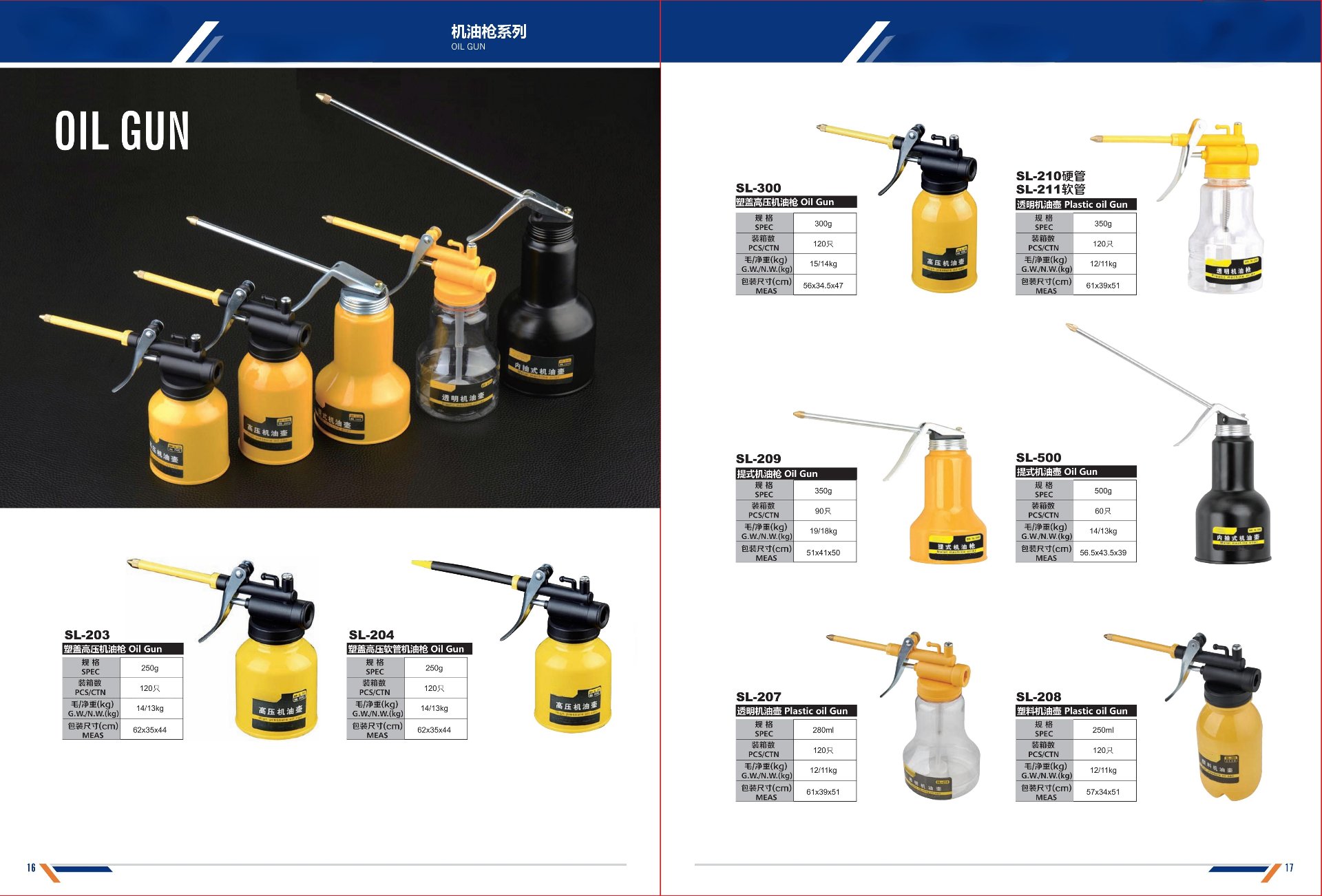
Plastic Oil Can SL-210 for Machine Shops
Plastic Oil Can (SL-210) — 350 ml Transparent Plastic Oil Gun
The SL-210 transparent plastic oil can lets technicians see remaining fluid at a glance. Lightweight and corrosion-proof, it is the practical plastic oil gun for garage and marine use where a clear reservoir matters.
| SKU | SL-210 |
|---|---|
| Material | Transparent PP / PET |
| Capacity | 350 ml |
| Net / Gross Weight | 200 g net / 240 g gross |
| Spout | Flexible clear spout |
| Application | Garage, marine, light industrial, DIY |
Key Features
Transparent body shows oil level
Lightweight and rust-proof
Flexible spout for tight spots
Safe for water-soluble and synthetic oils
OEM & Bulk Supply
Available for oil can wholesale and OEM oil gun China programs: MOQ from 500 pcs for stock colors, 1,000–3,000 pcs for custom logo, color, and packaging; container (FCL) orders welcome. Lead time 30–45 days for production. Payment: 30% T/T deposit + 70% against B/L, or 100% T/T for small orders. Each unit passes AQL 2.5 inspection (ISO 2859-1) and complies with RoHS / REACH.
Related buyer's guide: Oil Gun vs Oil Can: How to Choose the Right Lubrication Tool — capacity, spout, and material comparison for workshops and distributors.
Request a quote / private-label proposal
Custom Logo, Cards & Color for Oil Cans
TORCHMARK / Longrun Hardware supports B2B OEM and private-label programs for oil cans and lubrication tools. Available customization:
Custom logo: print your brand logo on the can body or lid for private-label programs.
Logo cards & hanging cards: we can supply retail display cards or hanging cards (৵卡) with your logo and barcode for shelf presentation.
Color customization: for large-quantity orders we can produce custom body colors to match your brand.
Packaging & OEM: export cartons, barcodes and private-label artwork per confirmed program.
Send your target model (SL-203 / SL-210 / YZDT2001 / YZDT2021), quantity, color and packaging format to confirm specification, sample plan and lead time.
Order Information & Inquiry Options
Contact our team with your required specification, order quantity and destination.
WhatsApp: +86 15867457689 — Amy
Email: amy@longrunhardware.com — for formal RFQ with target spec, quantity, destination port, and Incoterms (FOB Ningbo / CIF / DDP)
RFQ form: Request a Quote online — structured form, 15 fields, takes ~3 minutes
For OEM / private-label programs, please include your target spec, color, logo file (AI / PDF / PNG), retail box design, quantity, and destination port. Our export team will confirm specification, sample plan, lead time, and FOB / CIF pricing.
About the Author
Alisa Xu | Product Manager | Ningbo Torchmark Hardware Co., Ltd.
0086-13429254575 | Alisa Xu on LinkedIn
Plastic oil gun or metal oil can: what the material decides
The SL-210 is a 350 ml transparent plastic oil gun: PP/PET body, flexible clear spout, 200 g net and 240 g gross per unit. Buyers often treat it as a cheaper version of a metal oil can and price it accordingly, which is the wrong frame. The transparent body and the light weight solve two specific problems in a workshop, and the same properties create two specific limits. Distributors who understand both sell it into the right applications and keep it out of the wrong ones.
Where a transparent body earns its place
A technician servicing several machines carries several lubricants, and the most expensive mistake in that routine is applying the wrong one. A clear reservoir answers the question at a glance, without opening a cap or reading a label that has already worn off. That matters most in marine work, where the pot sits in a wet, salt-laden environment and labels fail faster than bodies, and in garages where gear oil, hydraulic oil and cutting fluid are all in use on the same bench.
Heat, solvent and sunlight limits
A PP/PET body is compatible with the light machine oils, hydraulic oils and water-soluble cutting fluids that dominate general maintenance. It is not the right container for solvent-based penetrants, for chlorinated cleaners, or for anything stored against a hot surface or in direct summer sunlight for long periods. Where a customer's lubricant is aggressive or the storage location is a hot plant room, a metal body is the correct specification regardless of price.
Drop behaviour in a workshop
A plastic body that is dropped on concrete scuffs and dents rather than deforming permanently, which is the practical advantage over a thin steel can. The failure mode to watch is the spout joint rather than the body: a flexible spout is a push fit at one end, and that is where a dropped tool leaks. Check the joint on the sample rather than the tank.
Lubricant families against body material
The table is a starting point for range planning. It is not a compatibility certification for any specific product — where the customer's lubricant is unusual, test it against a sample before ordering.
| Lubricant or fluid | Transparent PP/PET body | Coated steel body | Note |
|---|---|---|---|
| Light machine oil, spindle oil | Suitable | Suitable | Default application for both formats |
| Hydraulic oil | Suitable | Suitable | Level visibility is the deciding advantage |
| Water-soluble cutting fluid | Suitable | Check coating resistance | Water content attacks some coatings at the seam |
| Solvent-based penetrant | Not recommended | Check seal and coating | Specify a metal body and confirm seal material |
| Gear oil, heavier grades | Possible, slow flow | Suitable | Flexible spout restricts flow at high viscosity |
| Grease, NLGI 2 | Not suitable | Not suitable | Needs a grease gun, not an oil can |
Flexible spout against rigid spout
A flexible clear spout reaches a grease nipple, a chain run or a hinge that a rigid spout cannot point at, and it lets the technician see the oil arrive — which is the second reason the clear body matters. The trade is flow rate and durability: a flexible spout moves less volume per stroke than a rigid high-flow spout and it is the part that wears out first. Where the customer lubricates a production line on a schedule, the rigid high-flow format on the larger pot is the better specification; where the customer reaches into machinery, the flexible spout wins.
What the 200 g / 240 g figures tell a buyer
Net 200 g against gross 240 g means the packaging adds 40 g per unit, which is light enough that freight is calculated by volume rather than weight for this item. That changes the container maths: the pot loads efficiently by carton count, so the carton dimensions and the pieces per carton matter more than the unit weight. Ask for the confirmed carton specification with the quotation rather than estimating from the unit figure, and check it again if the packing changes for a private-label programme.
Compliance and documentation for retail markets
Each unit is inspected to AQL 2.5 under ISO 2859-1 sampling, and the product is supplied to RoHS and REACH requirements. For a retail programme, the documents that usually get asked for are the material declaration, the inspection record for the shipped lot and the artwork proof. Ask for the set your market requires at enquiry stage: a declaration cannot be produced retroactively for a lot that has already shipped. Buyers supplying into the EU should also confirm the labelling language and any packaging-recycling marking required in the destination country.
Questions buyers ask about plastic oil guns
Will the clear body yellow or craze over time?
PP/PET can discolour with prolonged UV exposure or aggressive fluids. Indoor workshop and marine use is fine; long-term outdoor storage is not, and metal is the better specification there.
Can the spout be replaced if it splits?
Confirm spout availability as a spare at quotation stage. The spout joint is the first part to fail on a dropped tool, so a spare line turns a return into a small sale.
Is 350 ml enough for a working day?
For intermittent lubrication yes; for continuous production-line use, the larger pressurised pot is the better fit. Capacity should follow the refill interruption cost, not the price.
Does it work with water-soluble cutting fluid?
Yes, the body is compatible. Check the cap seal and the label adhesive if the fluid is stored in the tool for weeks, since water content is what attacks those parts first.
What is the MOQ for a custom colour?
Stock colours start at 500 pieces. Custom logo, colour and packaging run from 1,000 to 3,000 pieces depending on the change, confirmed at artwork stage.
Which documents come with a retail order?
Material declaration to RoHS and REACH, the inspection record for the shipped lot and the approved artwork proof. Request them at enquiry stage; they cannot be issued after shipment.
Request a plastic oil gun quotation or sample
Send the lubricants your customers use, the spout type you want, the packing format and the destination market. We will confirm the body material, the spares list and the documentation set in writing.
WhatsApp: +86 15867457689 (Amy) · Email: amy@longrunhardware.com for formal RFQs · alisa@longrunhardware.com for specification questions for samples and documentation. Replies within 12 hours, Monday to Saturday.
Related: all oil cans and lubrication tools · YZDT2001 300 cc pressurised oil pot · YZDT2021 350 cc heavy-duty pot · CJ-037 / SL-203 250 g oil can · OEM process · factory tour · tools by industry · B2B sourcing guides · sourcing FAQ · brand-site range: Torchmark oil can collection.
Related Buying Guides
Lubrication tools are usually bought alongside hand tool programmes — see our B2B sourcing hub and sizing guide.
Questions buyers ask about oil cans
What capacity and spout types are available?
Common sizes run from 250 ml to 1 L for bench use, with flexible (bendable) and rigid spouts. Pick capacity by how much you oil in a session and spout type by whether you reach into tight fittings or pour openly.
What is the difference between a flexible and a rigid spout?
A flexible spout bends to reach grease nipples and awkward fill points; a rigid spout gives a straight, controlled stream for open caps and marks. Many buyers keep one of each.
Should I choose steel or brass for the oil can?
Steel is the general workshop standard; brass is specified where sparks or corrosion matter, such as flammable or marine environments. Both take the same oil, so the choice is about the setting, not the lubricant.
What is the vent cap for?
The vent cap equalises air pressure so the oil flows steadily when you pump the tap; keep it clear. A blocked vent makes the stream stall and the can hard to use.
What lubrication jobs are oil cans used for?
They feed way-oil to machine slides, light oil to hinges and linkages, and penetrating or way oil to pivots. For thick grease, a grease gun is the right tool; an oil can is for free-flowing lubricants.