


YZDT2021 Heavy-Duty Pressurised Oil Pot
Heavy-Duty Pressurized Oil Pot (YZDT2021) — 350cc Industrial-Grade Oil Pot
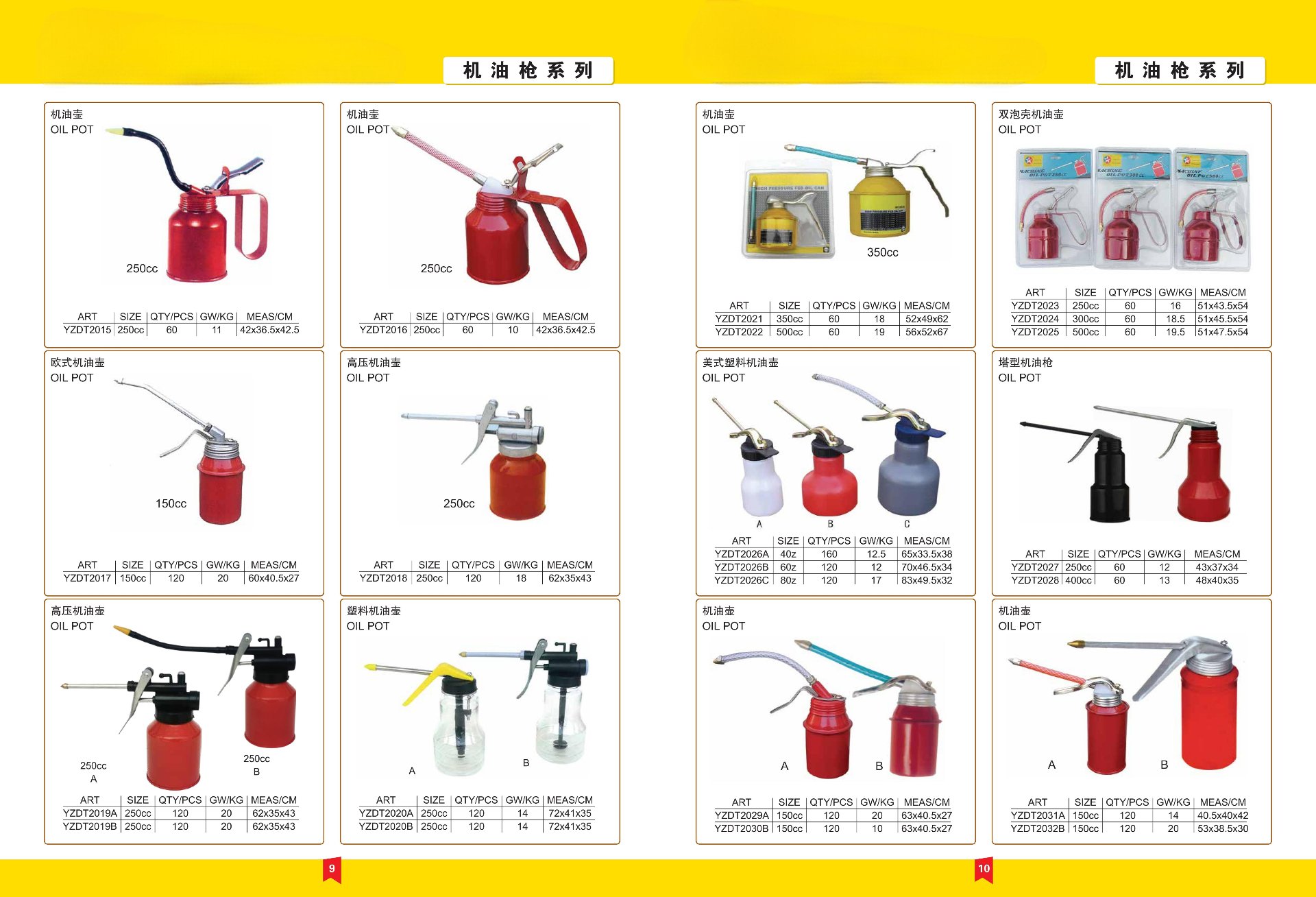
The YZDT2021 is a 350cc heavy-duty pressurized oil pot built for production lines, conveyor systems, and large workshop fleets. The thicker tank wall, reinforced pump assembly, and high-flow spout deliver consistent lubrication at scale, making it the preferred oil can for automotive assembly and industrial maintenance crews.
| SKU | YZDT2021 |
|---|---|
| Type | Thick-gauge steel + reinforced pump assembly |
| Capacity | 350cc |
| Net / Gross Weight | Net ~0.30 kg / Gross 18 kg per 60-ctn |
| Spout | High-flow rigid spout with shut-off valve |
| Application | Production lines, conveyor bearings, heavy machinery, fleet maintenance |
Key Features
Thicker tank wall for industrial daily use
Reinforced pump assembly for higher cycle life
High-flow spout with reliable shut-off valve
Designed for 100,000+ pump cycles without leakage
OEM & Bulk Supply
Available for pressurized oil pot wholesale and OEM oil pot China programs: MOQ from 500 pcs for stock configurations, 1,000–3,000 pcs for custom logo, color, and packaging; full container (FCL) orders welcome. Lead time 30–45 days for production. Payment: 30% T/T deposit + 70% against B/L, or 100% T/T for small orders. Each unit passes AQL 2.5 inspection (ISO 2859-1) and complies with RoHS / REACH.
Related buyer's guide: Oil Gun vs Oil Can: How to Choose the Right Lubrication Tool — capacity, spout, and material comparison for workshops and distributors.
Request a quote / private-label proposal
Custom Logo, Cards & Color for Oil Cans
TORCHMARK / Longrun Hardware supports B2B OEM and private-label programs for oil cans and lubrication tools. Available customization:
Custom logo: print your brand logo on the can body or lid for private-label programs.
Logo cards & hanging cards: we can supply retail display cards or hanging cards (৵卡) with your logo and barcode for shelf presentation.
Color customization: for large-quantity orders we can produce custom body colors to match your brand.
Packaging & OEM: export cartons, barcodes and private-label artwork per confirmed program.
Send your target model (SL-203 / SL-210 / YZDT2001 / YZDT2021), quantity, color and packaging format to confirm specification, sample plan and lead time.
Order Information & Inquiry Options
Contact our team with your required specification, order quantity and destination.
WhatsApp: +86 15867457689 — Amy
Email: amy@longrunhardware.com — for formal RFQ with target spec, quantity, destination port, and Incoterms (FOB Ningbo / CIF / DDP)
RFQ form: Request a Quote online — structured form, 15 fields, takes ~3 minutes
For OEM / private-label programs, please include your target spec, color, logo file (AI / PDF / PNG), retail box design, quantity, and destination port. Our export team will confirm specification, sample plan, lead time, and FOB / CIF pricing.
About the Author
Alisa Xu | Product Manager | Ningbo Torchmark Hardware Co., Ltd.
0086-13429254575 | Alisa Xu on LinkedIn
When a pressurised oil pot is the right answer
Most lubrication jobs need a drop or a trickle. A pressurised oil pot exists for the jobs where that is not enough, and knowing the difference is what keeps it from being the wrong purchase.
A hand pump moves oil slowly and precisely
A standard pump oil can delivers a controlled amount per stroke. For a hinge, a chain link or a small bearing, that control is the whole point of the tool.
Pressure delivers a stream, not drops
Pumping the body builds pressure so the oil leaves as a stream with force behind it. That is what reaches a conveyor bearing behind a guard or a point that is otherwise awkward to get at.
Where the extra force pays for itself
Production lines and fleet maintenance are measured in minutes saved. A job that takes four strokes instead of twenty is a job that gets done on schedule.
Where it costs more than it helps
On a precise bearing, a pressurised stream overfills the point and wastes oil. Control is the specification that matters there, which is the argument for a pump can instead.
Reading the 350 cc capacity
Capacity is the specification buyers glance at and rarely weigh. It decides how the tool fits a shift.
| Capacity | Suits | Trade-off |
| 350 cc | A round of scheduled lubrication points, one-handed work | Refills on a long route |
| 500 cc and above | Long routes without a refill, bench-top use | Heavier, harder to hold one-handed |
| Under 300 cc | Toolbox and pocket carry, occasional use | Refills mid-job on a production line |
350 cc balances reach against weight
The published net weight is about 0.30 kg, which is light enough to work one-handed for a full round. A larger can gets heavy faster than it gets more useful.
Refill discipline matters more than capacity
A route that runs a can dry halfway through is a scheduling problem rather than a capacity problem. Planning the refill point is usually the better fix.
Freight is quoted per carton, not per can
The published packing is 60 pieces per carton at 18 kg gross. That carton figure is what a forwarder needs, and it is not derivable from the net weight of one can.
The shut-off valve is the specification worth asking about
The pot has a high-flow rigid spout with a shut-off valve. Of the two words, the valve is the one that matters in service.
A valve stops the drip between points
An open spout drips while the operator walks to the next point. On a clean production floor that drip is a housekeeping problem as much as a waste problem.
It also stops the mess in transit
A can stored on its side in a toolbox with the spout open leaks. The valve is what makes the tool stowable.
Rigid spouts reach further than flexible ones
A rigid spout can be placed precisely and holds its position. A flexible spout bends around an obstruction, which is the reason both exist rather than one.
High-flow is a choice, not always a benefit
Flow rate is useful on a large bearing and wasteful on a small one. If the application is precision lubrication, flow rate is the wrong thing to optimise.
Build quality and what fails first
The published build is thick-gauge steel with a reinforced pump assembly. Both choices address a specific failure mode.
Steel body survives a workshop
A thin steel or plastic body dents, and a dented body does not pressurise reliably. Thick-gauge steel is what keeps the seal working after the first knock.
The pump assembly is the wearing part
Seals and the piston are what wear. A reinforced assembly is the difference between a tool that lasts a season and one that lasts years.
The seal is what stops pressurising
When a pot will not build pressure, the cause is almost always the seal or the filler cap rather than the body. Both should be replaceable parts.
Thick-gauge adds weight where it counts least
The extra material is in the body, which is carried, not in the hand, which works. That is why the net weight stays low despite the heavier gauge.
Where this pot is the wrong choice
Naming the limits is what keeps a distributor from selling it into the wrong application.
Precision bearings and small points
A pressurised stream overfills a small point. A pump oil can with a controlled stroke is the correct tool for precision work.
Where a flexible spout is needed
An obstruction between the operator and the point calls for a flexible spout. A rigid spout cannot bend around it.
Continuous high-volume lubrication
Anything that needs a steady supply over a long period is a job for a gravity-feed or a pumped system, not a hand-held pot.
Aggressive or solvent-thinning fluids
Seal material compatibility decides whether the pot survives the fluid. Confirm the fluid before confirming the tool.
What to check on a sample before an order
Four checks on one unit.
Pump it and see whether it holds pressure
Build pressure and leave it for a minute. A pot that loses pressure without being used has a seal or a cap problem.
Work the shut-off valve repeatedly
Open and close it a dozen times. A valve that stiffens or drips after a few cycles will drip in service.
Check the spout is secure under pressure
A spout that weeps at its joint under pressure is the defect that shows up as a complaint rather than a return.
Confirm the carton and artwork
Sixty pieces per carton at 18 kg gross. A retail programme needs barcode and language marking confirmed before artwork approval.
Questions buyers ask about the YZDT2021
What is the difference between this and a pump oil can?
This builds pressure so oil leaves as a stream with force, reaching awkward points quickly. A pump can delivers controlled drops, which is right for precision work.
Is 350 cc enough for a maintenance round?
For a scheduled round of points, yes, and it stays light enough to use one-handed at about 0.30 kg net. A longer route is better planned around a refill point.
Does the valve stop dripping?
Yes, that is its purpose. It prevents drips while moving between points and stops the can leaking when stored on its side.
Can it be used with any oil?
Seal compatibility decides that. Confirm the fluid against the seal material before confirming the tool, particularly with solvent-thinning products.
What is the packing for freight?
Sixty pieces per export carton at 18 kg gross. Quote freight on that carton figure, not on the 0.30 kg net weight of a single can.
Can we add our brand and packaging?
Logo, colour and retail packaging are OEM options quoted against the configuration. Raise it at the enquiry because artwork approval affects the lead time.
Request a quotation for the YZDT2021
Send the quantity, packaging requirement and destination, and we will return packing data and a quotation. Email amy@longrunhardware.com, alisa@longrunhardware.com, or message us on WhatsApp at +86 158 6745 7689. Product Manager Alisa Xu handles this range. Pump oil cans are covered in the pump oil can buying guide, capacity choices in the 300 cc versus 500 cc guide, and carton data in the oil can shipping data guide. The high-pressure range is on the CJ-018 and CJ-024 page, seals and spouts on the oil can spare parts page, and the full range sits under oil cans and lubrication tools. Branding options are on the OEM packaging guide, and OEM terms are listed on the OEM process page.
Where the application needs a lighter, lower-capacity unit for bench work, compare this pot with the CJ-037 / SL-203 high-pressure oil can.
Related Buying Guides
Lubrication tools are usually bought alongside hand tool programmes — see our B2B sourcing hub and sizing guide.
Questions buyers ask about oil cans
What capacity and spout types are available?
Common sizes run from 250 ml to 1 L for bench use, with flexible (bendable) and rigid spouts. Pick capacity by how much you oil in a session and spout type by whether you reach into tight fittings or pour openly.
What is the difference between a flexible and a rigid spout?
A flexible spout bends to reach grease nipples and awkward fill points; a rigid spout gives a straight, controlled stream for open caps and marks. Many buyers keep one of each.
Should I choose steel or brass for the oil can?
Steel is the general workshop standard; brass is specified where sparks or corrosion matter, such as flammable or marine environments. Both take the same oil, so the choice is about the setting, not the lubricant.
What is the vent cap for?
The vent cap equalises air pressure so the oil flows steadily when you pump the tap; keep it clear. A blocked vent makes the stream stall and the can hard to use.
What lubrication jobs are oil cans used for?
They feed way-oil to machine slides, light oil to hinges and linkages, and penetrating or way oil to pivots. For thick grease, a grease gun is the right tool; an oil can is for free-flowing lubricants.