

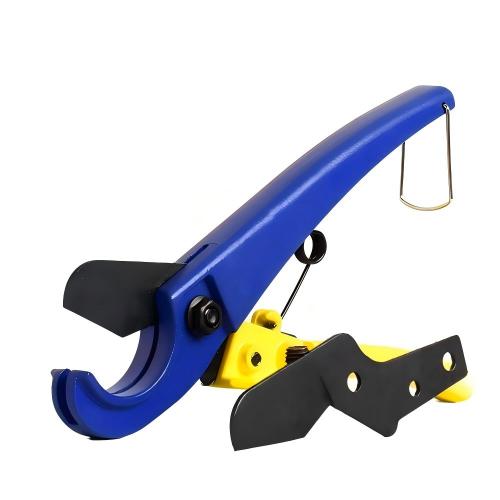
32mm Portable Pvc Pipe Cutter
32mm Portable Pvc Pipe Cutter
Handle material: Alumunium Alloy
Blade: Teflon Surface Treatment
Cutting Dia: 32mm
Suitable for much softer pipe, especially PVC-U pipe and PVC pipe, which may be out of shape when using the ratchet pipe cutter.
Order Information & Inquiry Options
Choose whichever channel fits your buying process — we reply to all three within 12 hours, Monday to Saturday.
WhatsApp: +86 15867457689 — Amy
Email: amy@longrunhardware.com — for formal RFQ with target spec, quantity, destination port, and Incoterms (FOB Ningbo / CIF / DDP)
RFQ form: Request a Quote online — structured form, 15 fields, takes ~3 minutes
For OEM / private-label programs, please include your target spec, color, logo file (AI / PDF / PNG), retail box design, quantity, and destination port. Our export team will confirm specification, sample plan, lead time, and FOB / CIF pricing.
About the Author
Alisa Xu | Product Manager | Ningbo Torchmark Hardware Co., Ltd.
0086-13429254575 | Alisa Xu on LinkedIn
Specification
| Parameter | Value |
|---|---|
| Cutting capacity | 32 mm |
| Format | Portable — compact body for tool-bag carry |
| Intended pipe | PVC and plastic hose |
| Cut finish | Square, burr-free |
| Blade | Replaceable |
| OEM | Supported — colour, logo, retail packaging |
What “portable” actually buys you
Carried, not fetched
The value of a compact cutter is that it is on the installer when the cut is needed. A 32 mm cutter is small and light enough to stay in a tool bag alongside hand tools, which removes the trip back to the van that a larger cutter causes.
Tight spaces
Small-bore work is often inside cabinets, under sinks and against walls. A compact body opens in less space than a large-diameter tool, which is frequently the deciding factor rather than capacity.
Enough capacity for most call-outs
32 mm covers the small-bore supply and hose work that dominates service and repair. The jobs that need more are the exception, and they justify carrying a second tool.
Choosing sizes for a stocking range
32 mm for service and repair
Service vans, maintenance teams and repair work. The tool is bought for convenience as much as capacity.
36 mm and 42 mm for installation
New installation runs into larger diameters more often. Most distributors stock a compact cutter for service and a 42 mm general-purpose cutter for installation, because the two address different jobs.
Confirm the outside diameter
PVC is sized differently between markets, and a nominal 1 in pipe is not the same outside diameter as a nominal 25 or 32 mm one. Measure before ordering.
Frequently asked questions
What is the maximum pipe it will cut?
32 mm outside diameter. Confirm against the pipe you install, because nominal size and OD differ.
Will it cut flexible hose?
Yes, within capacity. For thin-wall flexible hose, support the pipe so it does not deform during the cut.
Does it need deburring afterwards?
No. The shear leaves a square, burr-free face ready for solvent welding.
Is the blade replaceable?
Yes. Spare blades should be ordered with the tools.
Can we brand it?
Yes — colour, logo and retail packaging. Send artwork with the enquiry.
What should the enquiry include?
Capacity, pipe materials, blade spare quantity, packaging format, quantity and destination port.
Related tools and guides
Send your required specification, order quantity and destination to our export team for a quotation covering price, MOQ, lead time and sample cost.
Related Buying Guides
Building a plastic pipe tooling line? These guides cover sizing standards and B2B sourcing basics.
Questions buyers ask about PVC pipe cutters
What is the difference between a ratcheting and a scissor-style PVC cutter?
A scissor cutter is light and fast for small-diameter, low-wall pipe you cut all day; a ratcheting cutter multiplies your force for larger or thicker-wall PVC and CPVC with less hand fatigue. Choose by the largest diameter you regularly cut.
What is the maximum diameter a PVC pipe cutter handles?
Scissor cutters typically cover up to about 42 mm (1-1/4 in); ratcheting models reach 50-63 mm (2-2-1/2 in) and heavy models a bit more. Cutting beyond rated capacity damages the blade and leaves a ragged edge.
How do I get a square, burr-free cut?
Mark a square line, keep the cutter square to the pipe, and close in steady strokes rather than twisting. A light pass with a deburring tool on the inside edge removes the lip that restricts flow and snags fittings.
When should I replace the blade?
Replace when cuts need more force, start to crush rather than slice, or leave a ragged or angled edge. A sharp blade cuts cleaner and puts less stress on the joint; keep a spare blade in the kit.
Can the same cutter be used on PEX or CPVC?
CPVC cuts like PVC with the same tool. PEX is better cut with a dedicated PEX/scissor cutter or a tubing shears to avoid distorting the bore; a PVC ratchet can pinch PEX out of round.
Color card and single blister
Double blister
Box