

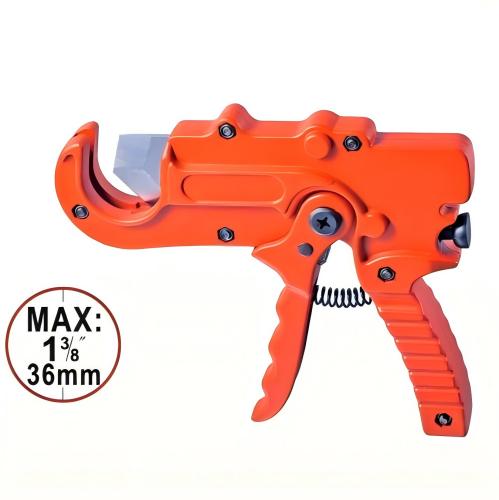
36mm labor-save PPR Pipe Cutter
Factory/supplier/manufacturer of plastic pipe cutters for pvc pipes, pe pipes and ppr pipes, covering 36mm, 42mm,50mm, 63mm.
Order Information & Inquiry Options
Contact our team with your required specification, order quantity and destination.
WhatsApp: +86 15867457689 — Amy
Email: amy@longrunhardware.com — for formal RFQ with target spec, quantity, destination port, and Incoterms (FOB Ningbo / CIF / DDP)
RFQ form: Request a Quote online — structured form, 15 fields, takes ~3 minutes
For OEM / private-label programs, please include your target spec, color, logo file (AI / PDF / PNG), retail box design, quantity, and destination port. Our export team will confirm specification, sample plan, lead time, and FOB / CIF pricing.
About the Author
Alisa Xu | Product Manager | Ningbo Torchmark Hardware Co., Ltd.
0086-13429254575 | Alisa Xu on LinkedIn
Specification
| Parameter | Value |
|---|---|
| Cutting capacity | 36 mm |
| Operation | Labour-saving ratchet, one-hand |
| Intended pipe | PPR and PVC |
| Cut finish | Square, burr-free — no sanding before fusion |
| Blade | Replaceable |
| OEM | Supported — colour, logo, retail packaging |
Why cut quality decides whether a PPR joint holds
Fusion needs a square face
A PPR joint is made by heating both the pipe end and the fitting and pushing them together. If the pipe face is not square, the molten surfaces meet unevenly and the joint is stressed before it is ever pressurised. A shear cutter gives the square face that fusion needs; a saw does not.
Burrs restrict flow and catch debris
An internal burr left by a saw or a knife narrows the bore and gives deposits somewhere to collect. Cutting clean removes the deburring step entirely.
Ratchet action keeps the cut straight
The ratchet advances the blade in small increments, which is what stops the blade wandering on a round pipe. On a labour-saving design the operator completes a 36 mm cut with light repeated squeezes rather than one hard grip.
Where 36 mm fits in a range
The most-carried size
36 mm covers the small-bore supply and hose work that makes up the majority of daily call-outs, and the tool is light enough to live in a bag. Most installers reach for this size first.
Stepping up to 42 mm
Where drainage or larger supply lines appear, 42 mm is the practical next size and covers 3–42 mm in one tool. Stocking 36 mm and 42 mm covers nearly everything without overlap.
Checking the outside diameter
PPR and PVC are sized differently between markets. Measure the pipe you install and confirm against the stated capacity — nominal pipe size is not outside diameter.
Frequently asked questions
Will it cut PVC as well as PPR?
Yes, within the 36 mm capacity. Confirm wall thickness for heavy-wall pipe.
Do we still need to deburr?
No. The shear leaves a square, burr-free face, so the pipe can go straight to fusion or solvent welding.
Is it a one-hand tool?
Yes — the ratchet design is intended for one-hand operation, which matters when the other hand is holding the pipe.
Is the blade replaceable?
Yes. Order spare blades with the tools; a dull blade is the usual reason a cut drifts out of square.
Can we brand it?
Yes — colour, logo and retail packaging are supported. Send artwork with the enquiry.
What should the enquiry include?
Capacity, pipe materials, blade spare quantity, packaging format, quantity and destination port.
Related tools and guides
Send your required specification, order quantity and destination to our export team for a quotation covering price, MOQ, lead time and sample cost.
Related Buying Guides
Building a plastic pipe tooling line? These guides cover sizing standards and B2B sourcing basics.
Questions buyers ask about PVC pipe cutters
What is the difference between a ratcheting and a scissor-style PVC cutter?
A scissor cutter is light and fast for small-diameter, low-wall pipe you cut all day; a ratcheting cutter multiplies your force for larger or thicker-wall PVC and CPVC with less hand fatigue. Choose by the largest diameter you regularly cut.
What is the maximum diameter a PVC pipe cutter handles?
Scissor cutters typically cover up to about 42 mm (1-1/4 in); ratcheting models reach 50-63 mm (2-2-1/2 in) and heavy models a bit more. Cutting beyond rated capacity damages the blade and leaves a ragged edge.
How do I get a square, burr-free cut?
Mark a square line, keep the cutter square to the pipe, and close in steady strokes rather than twisting. A light pass with a deburring tool on the inside edge removes the lip that restricts flow and snags fittings.
When should I replace the blade?
Replace when cuts need more force, start to crush rather than slice, or leave a ragged or angled edge. A sharp blade cuts cleaner and puts less stress on the joint; keep a spare blade in the kit.
Can the same cutter be used on PEX or CPVC?
CPVC cuts like PVC with the same tool. PEX is better cut with a dedicated PEX/scissor cutter or a tubing shears to avoid distorting the bore; a PVC ratchet can pinch PEX out of round.
Small trial orders for cutter and pipe-tool ranges
To build a cutting-tool range, a small trial order covering the pipe diameters and materials you serve is a practical start. We confirm the applicable minimum for each item per order.
Send the pipe diameter, the material (PVC, PPR or copper) and your first-order quantity, and we will confirm the matching cutter, packing and terms.
Factory/supplier/manufacturer of plastic pipe cutters for pvc pipes, pe pipes and ppr pipes, covering 36mm, 42mm,50mm, 63mm.