


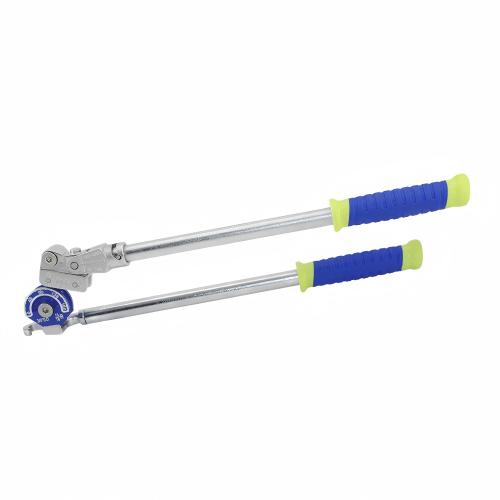
Heavy-Duty Manual Tube Bender 5mm-22mm
Professional Heavy-Duty Tube Benders for Precision Engineering
Engineered for Excellence, Built for Industry
When your project demands a perfect 180° bend in rigid materials like stainless steel or iron, "standard" benders often fail, leading to flattened arcs or scored surfaces. The Longrun Hardware TB-365 Series is engineered specifically to eliminate these risks.
Why the TB-365 Series Outperforms the Competition
1. Innovative Two-Stage Design
Our unique two-stage handle system allows for high-leverage bending even at extreme angles. This design reduces the physical force required by up to 30%, allowing for a smooth, continuous motion from 0° to 180° without needing to reposition the tool mid-bend.
2. Friction-Reducing Roller Wheel
Unlike static mandrels that "drag" against the pipe, our Bender Wheel design rolls with the tube. This significantly reduces friction, preventing surface scratches and ensuring the tube wall maintains a consistent thickness throughout the radius.
3. Wide-Range Compatibility (5mm to 22mm)
Whether you are working with small-diameter hydraulic lines or large-scale HVAC piping, the TB365 series covers all essential sizes in both Metric and Imperial units:
Precision Sizes: 3/16" (5mm) to 7/8" (22mm).
Bending Radius: Optimized from 14mm to 80.8mm to ensure zero-deformation.
Technical Specifications Table
| Item No. | Size (Inch/Metric) | Bending Radius (mm) | Best For |
| TB365-04 | 1/4" (6mm) | 13.8 | Instrument lines |
| TB365-08 | 1/2" (12mm) | 36.3 | HVAC / Refrigeration |
| TB365-10 | 5/8" (16mm) | 53.5 | Hydraulic systems |
| TB365-14 | 7/8" (22mm) | 80.8 | Industrial Piping |
Key Features at a Glance
Multi-Material Mastery: Effortlessly bends Annealed Stainless Steel, Copper, Aluminum, and Iron.
Ergonomic Grips: Non-slip, blue-and-yellow handles designed for high-torque applications.
Adjustable Handles: start angle allows for easy operation in confined spaces.
Clear Graduations: Deeply etched markings for 45°/90°/135°/180° or repeatable accuracy.
Directly from the Factory: Longrun Hardware Advantage
As a specialized manufacturer, we support your business with:
Bulk Wholesale Pricing: Competitive margins for distributors.
OEM/ODM Services: Custom branding and sizing available.
Global Shipping: Reliable logistics to ensure your inventory stays stocked.
Need a Reliable Supply Partner?
"Longrun Hardware tools have become the standard for our HVAC technicians. The roller wheel design saved us thousands in ruined copper tubing last year." — Industrial Partner Review
Get a Quote Today
Stop settling for tools that ruin your materials. Choose the TB365 tube bender for perfect bends every time.
Would you like a full technical PDF of the tube bender or a customized quote for your first bulk order?
Order Information & Inquiry Options
Choose whichever channel fits your buying process — we reply to all three within 12 hours, Monday to Saturday.
WhatsApp: +86 15867457689 — Amy
Email: amy@longrunhardware.com — for formal RFQ with target spec, quantity, destination port, and Incoterms (FOB Ningbo / CIF / DDP)
RFQ form: Request a Quote online — structured form, 15 fields, takes ~3 minutes
For OEM / private-label programs, please include your target spec, color, logo file (AI / PDF / PNG), retail box design, quantity, and destination port. Our export team will confirm specification, sample plan, lead time, and FOB / CIF pricing.
About the Author
Alisa Xu | Product Manager | Ningbo Torchmark Hardware Co., Ltd.
0086-13429254575 | Alisa Xu on LinkedIn
Choosing between the four sizes
Most first orders include all four sizes, then repeat only 1/2 in and 5/8 in. If your market is residential split systems, 1/2 in will carry the line; if you sell into light commercial or hydraulic service, 5/8 in and 7/8 in earn their shelf space. The 1/4 in size is rarely reordered in volume but is the one that wins the instrument and gauge work.
The forming radius quoted for each size (13.8 mm at 1/4 in up to 80.8 mm at 7/8 in) is the number that decides whether a bend will fit the void on site. Ask the customer for the radius they need before you recommend a size — a bender that produces too large a radius is returned as often as one that kinks.
Three questions buyers ask before ordering
Does the set bend stainless? Thin-wall annealed stainless, at the larger sizes, with care. Heavier wall or hard temper needs a different method. Send the wall thickness and we will answer for your specific tube rather than in general.
What wears out first? The roller and the shoe groove. Both are available as spare parts, which is what keeps a set in service instead of in a bin.
Can we consolidate with flaring tools? Yes. The bender shares a carton footprint with the flaring kits in this range, so one mixed container covers cut, deburr, flare and bend.
Full specification, radius table and OEM options for this set are listed on our tube bender set page.
Reading the bend radius column
Most tube bender listings give a size range and stop there. This range publishes the bending radius for each size, and that number is the one that decides whether a bend survives. The same principle is set out in the copper pipe cutting and bending guide.
| Item | Size | Bending radius | Best for |
| TB365-04 | 1/4 in (6 mm) | 13.8 mm | Instrument lines |
| TB365-08 | 1/2 in (12 mm) | 36.3 mm | HVAC and refrigeration |
| TB365-10 | 5/8 in (16 mm) | 53.5 mm | Hydraulic systems |
| TB365-14 | 7/8 in (22 mm) | 80.8 mm | Industrial piping |
Radius is what stops a flat spot
Bending tighter than the radius the tube tolerates collapses the section and restricts flow. The published radius is the figure the former is cut to, which is why it belongs on the quotation.
The radius grows faster than the diameter
Doubling the tube size roughly triples the radius on this range. That is why a compact bender for 6 mm does not scale to 22 mm, and why the larger sizes need a longer lever.
Why the four sizes are spaced this way
6 mm for instrumentation, 12 mm for HVAC, 16 mm for hydraulic and 22 mm for industrial pipe. Those are four different customers rather than four sizes of the same job.
Check the radius against the space available
A bend that needs 80.8 mm of radius does not fit behind every panel. Where space is tight, the tube size or the routing has to change rather than the tool.
Choosing between the four sizes
This is a range of four separate tools rather than one adjustable one. That distinction matters to a stocking decision, and it is the same decision a buyer faces across the flaring and bending kit range.
Four formers, four stock lines
Each size is its own bender, so a distributor chooses which to carry. Stocking all four is a commitment; stocking the two that match the customer base is usually the better first order.
1/2 in is the HVAC volume size
TB365-08 covers the size that appears most on residential and light commercial refrigerant work. It is the one to stock first for an HVAC channel.
5/8 in for hydraulic work
TB365-10 serves hydraulic systems, which is a different buyer with different volume. Carrying it alongside the HVAC size widens the channel without overlapping.
7/8 in is the industrial end
TB365-14 is for industrial pipe and is the least frequently ordered. It earns its place as a completeness item rather than a volume line.
What heavy-duty means on a hand bender
The description carries a load rating in practice rather than a number. Three things make a bender heavy-duty.
The former does not flex
A former that spreads under load produces a bend that is off radius and slightly flattened. Rigidity in the former is what makes the published radius true on every bend.
The lever does not bend
On 22 mm tube the lever carries real force. A handle that flexes is both a safety issue and the reason a bend comes out short.
The pivot takes the wear
The pivot is the wearing part on a lever bender. A plain pin wears oval, and an oval pivot shows up as inconsistent bend angles.
Weight is the trade-off
Heavy-duty means more material, which means more weight in the bag. That is why a compact bender still has a place for small-diameter work, and why some buyers prefer a combined flaring and bending set for mixed jobs.
Material behaviour across the range
The same bender gives different results on different tube, and the size makes it worse. Sizing conventions add a second trap, covered in the inch versus metric sizing note.
Annealed copper is the easy case
Soft copper forms cleanly to the published radius. Hard-drawn copper springs back and has to be taken past the target angle.
Aluminium cracks before copper does
Aluminium work-hardens faster and is less forgiving on a tight radius. On the larger sizes, aluminium is the material most likely to fail.
Stainless springs back most
Thin-wall stainless bends but returns noticeably. Plan to overshoot, and expect the overshoot to grow with tube size.
Steel needs the wall confirmed
Only thin-wall steel is in specification. Thicker wall needs more force than a hand tool should be asked to deliver.
Where this bender is the wrong answer
Three situations where the recommendation should be something else.
Tight-space small work
On 6 mm tube in a confined space, an internal spring is faster and cheaper. A lever bender is the wrong tool for a one-off tight bend; the single-size TB364 lever bender is closer to that kind of job.
Repetitive production bending
Volume work at a fixed radius belongs on powered equipment. A hand bender is a field and low-volume tool.
Sizes outside the four
A tube size with no matching former cannot be bent properly. Adapting a former to a size it was not cut for produces a flattened bend, and the FT-2030AM and BT-369M combination set covers the sizes this range does not.
Questions buyers ask about the TB365 range
What are the bending radii?
13.8 mm on 1/4 inch, 36.3 mm on 1/2 inch, 53.5 mm on 5/8 inch and 80.8 mm on 7/8 inch. The radius is what stops a bend flattening.
Is it one tool or four?
Four separate benders, one per size. A distributor chooses which to stock, and 1/2 inch is the volume size for an HVAC channel.
Will it bend stainless?
Thin-wall stainless, yes, with noticeable springback that grows with tube size. Thick-wall tube needs more force than a hand tool provides.
Why is the radius so much larger on 7/8 inch?
Because the tube needs it. Bending 22 mm tube to a 13.8 mm radius would collapse the section, which is why the former is cut to 80.8 mm.
Can it be used in tight spaces?
On the larger sizes, no. A bend needing 80.8 mm of radius does not fit behind every panel, so the routing or the tube size has to change.
Can we add our brand and packaging?
Logo, handle colour and retail packaging are OEM options quoted against the configuration. Raise it at the enquiry because artwork approval affects lead time.
Request a quotation for the TB365 range
Send the sizes required, quantity, packaging and destination, and we will return packing data and a quotation. Email amy@longrunhardware.com, alisa@longrunhardware.com, or message us on WhatsApp at +86 158 6745 7689. Product Manager Alisa Xu handles this range. The single-size lever bender is on the TB364 page, the combination kit on the FT-2030AM and BT-369M page, and the wider range sits under pipe and tube benders. Bending technique is covered in the copper pipe cutting and bending guide, HVAC applications in the HVAC installation tools guide, and OEM terms are on the OEM process page.
Related Buying Guides
Bending and tube-end preparation go together — these guides cover bender selection and metric vs inch tooling.
Questions buyers ask about pipe and tube benders
What is the difference between a spring bender and a hydraulic bender?
A spring bender is a low-cost hand tool for small copper and PVC tube where you slide a coiled spring over the tube to prevent collapse; a hydraulic bender pushes the tube against a form for larger diameters and tighter, repeatable angles. Pick by tube diameter and how many bends per day.
What bend radius should I use for copper or steel tube?
Keep to the manufacturer's minimum centre-line radius - typically 1.5 to 2 times the tube outside diameter for copper. Tighter than that and the wall flattens or kinks; wider than needed wastes space in the run.
How do I avoid kinking the tube when bending?
Use the correct-size former or spring, keep the tube supported through the bend, and bend smoothly rather than in one jerk. For thin-wall tube, a former that supports the inside (internal mandrel or full-radius spring) is the difference between a clean bend and a kink.
Can these benders handle stainless and aluminum tube?
Aluminum bends much like copper with the right radius; stainless needs more force and a hydraulic or mandrel bender because it work-hardens. Match the former material and the tool capacity to the tube you actually run.
How accurate is the bend angle?
Good hand benders hold the marked angle to within a few degrees when you watch the gauge; hydraulic models with angle stops are more repeatable across a batch. For layout-critical runs, mark and check the first piece before doing the lot.
Small trial orders for tube benders
If your market centres on a few tube sizes, a small trial order of the matching benders lets you confirm fit and demand before volume. We confirm the applicable minimum for each item per order.
Send the tube size (metric or inch), your first-order quantity and destination port, and we will reply with packing and order terms.