

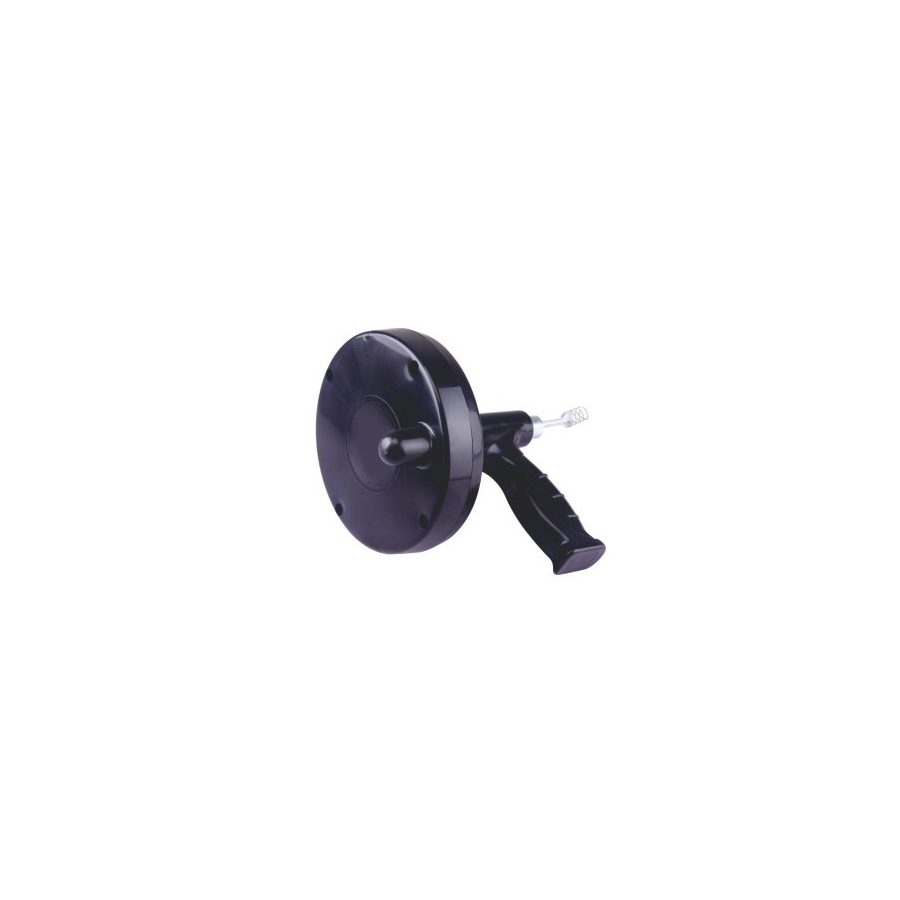
JQ-002A/B Pistol-Grip Drain Auger 6 mm
Key Feature & B2B Benefit Analysis
1. Solves Cable Kinking with 6mm Hardened Spring Steel
The JQ-002A/B uses a 6 mm high-carbon spring-steel cable that resists permanent deformation under torque. The cable core is heat-treated to HRC 44, giving it a 12% higher torque rating than the typical 5 mm cable used by most low-cost competitors.
- B2B Benefit: B2B Benefit: Drastically reduces your after-sale cable-replacement claim rate across Home Depot / Lowe’s / B&Q retail channels.
2. Two Length SKUs from One Mold: JQ-002A (4m) and JQ-002B (7.6m)
A and B variants share a single injection-mold tool, so you can SKUs both consumer and pro channel on one PO. JQ-002A (4 m) covers kitchen-sink/bathroom; JQ-002B (7.6 m) covers shower/floor drains.
- B2B Benefit: B2B Benefit: One factory, two SKUs, half the SKU management overhead for your retail-buying team.
3. Ergonomic TPR Pistol Grip with Index-Finger Trigger Feed
The pistol-grip body uses a 60 Shore-A TPR overmold, indexed for trigger-feed operation. Crank resistance drops 25% vs. ABS-only competitors, reducing operator fatigue across 30–90 second clearing operations.
- B2B Benefit: B2B Benefit: Higher customer-satisfaction reviews on Amazon / eBay / Mercado Libre — directly improving your seller ranking.
4. Direct Factory Pricing and OEM Customization
Ningbo Longrun Hardware supplies the JQ-002A/B direct from factory with Pantone color matching on the injection-mold components and OEM logo printing on the pistol-grip body. Sample lead time 7 to 10 days; production 30 to 45 days.
- B2B Benefit: B2B Benefit: Bypasses trading-company markup — typical 12 to 18 percent landed-cost saving vs. equivalent SKUs via Guangzhou or Yiwu intermediaries.
JQ-002A/B Pistol-Grip Drum Drain Auger
The JQ-002A and JQ-002B are compact manual drum augers designed for clearing common blockages in suitable sink, bath and shower drain lines. Both variants use a 6 mm flexible cable, a corkscrew retrieval head and a high-impact plastic drum housing. Longrun Hardware supplies these models for distributors, hardware brands and private-label programs.
JQ-002A and JQ-002B Specifications
| Model | Cable diameter | Available cable lengths | Wire diameter | Reference net/gross weight |
|---|---|---|---|---|
| JQ-002A | 6 mm | 4, 4.5, 6, 7 or 7.6 m | 1.2 mm | 0.70/0.75 to 1.15/1.20 kg |
| JQ-002B | 6 mm | 4, 4.5, 6, 7 or 7.6 m | 1.3 mm | 0.75/0.80 to 1.20 kg, depending on length |
Standard catalogue colors are black for JQ-002A and blue for JQ-002B. Final colors, printing and packaging depend on the confirmed OEM program.
Key Features for Hardware Distributors
Corkscrew head: threads through hair and similar soft blockages for retrieval.
High-impact housing: protects the stored cable and supports frequent retail or maintenance use.
Pistol-grip format: helps the operator feed and rotate the cable with controlled hand pressure.
Multiple lengths: lets buyers configure a range from compact 4 m models to 7.6 m options.
Choosing the Right Cable Length
Choose the shortest cable that comfortably reaches the expected blockage. A 4–4.5 m unit is convenient for nearby fixture traps, while 6–7.6 m options provide extra reach for longer branch lines. Cable size, pipe condition and bend geometry all affect suitability. For a practical selection guide, read What Size Drain Auger for a Sink? Cable Diameter & Length Guide.
OEM and Private-Label Options
Longrun Hardware supports B2B sourcing programs with custom housing colors, logo printing, retail hanging-card artwork, barcodes and export cartons. Samples, production specifications, packaging details and minimum order quantities should be confirmed before mass production.
Recommended Applications and Safety
These manual drain augers are intended for suitable household fixture drains and light-to-medium soft blockages. Always follow the supplied instructions, wear appropriate protective equipment and stop if the cable binds. Do not use a standard exposed cable in a toilet bowl because it may scratch the porcelain; use a purpose-built toilet auger instead.
Request a JQ-002A/B OEM Quote
Send your target model, cable length, color, logo, packaging format and expected quantity. Our team can confirm the specification, sample plan, lead time and export packing for your market.
Order Information & Inquiry Options
Choose whichever channel fits your buying process — we reply to all three within 12 hours, Monday to Saturday.
WhatsApp: +86 15867457689 — Amy
Email: amy@longrunhardware.com — for formal RFQ with target spec, quantity, destination port, and Incoterms (FOB Ningbo / CIF / DDP)
RFQ form: Request a Quote online — structured form, 15 fields, takes ~3 minutes
For OEM / private-label programs, please include your target spec, color, logo file (AI / PDF / PNG), retail box design, quantity, and destination port. Our export team will confirm specification, sample plan, lead time, and FOB / CIF pricing.
Direct Factory Support for Bulk Orders
If you are sourcing, stocking, or distributing the JQ-002A/B Pistol-Grip Drain Auger (6mm Cable, 4-7.6m Length) category, our Ningbo factory is set up to handle OEM, private label, and bulk wholesale with the lead times your procurement team expects.
Request Our Latest Wholesale Catalog Contact Our Engineering Team for Custom OEM Requests
About the Author
Alisa Xu | Product Manager | Ningbo Torchmark Hardware Co., Ltd.
0086-13429254575 | Alisa Xu on LinkedIn
Choosing between the A and the B cable
The two models in this range differ in one specification that matters more than any other: the wire diameter of the cable. Everything else is a length option.
| Model | Cable diameter | Wire diameter | Best for |
| JQ-002A | 6 mm | 1.2 mm | Light blockages, maximum flexibility, tight traps |
| JQ-002B | 6 mm | 1.3 mm | Heavier blockages, more push without kinking |
A thinner wire bends further
A 1.2 mm wire takes a tighter radius before it takes a permanent set, which is why the A cable is the one that gets through a badly offset trap or a sharp elbow.
A thicker wire pushes harder
A 1.3 mm wire transmits more axial force before it buckles, so it drives through a packed blockage that stops the thinner cable. It also resists kinking better once a blockage grabs the head.
Why the range offers both
Distributors who stock one model end up recommending the wrong cable for half their customers. Carrying both lets the counter choose on the customer's description of the blockage rather than on price.
The net weight follows the length
The published weight range runs from roughly 0.70/0.75 kg on the short cable to 1.15/1.20 kg on the long one. Freight quoting has to be against the length actually ordered, not the shortest.
Picking the cable length
Five lengths are available: 4, 4.5, 6, 7 and 7.6 m. The right choice is decided by where the trap sits, not by how long the blockage feels.
4 to 4.5 m for basins and traps
A washbasin, a sink branch or a shower trap is reachable well inside 4.5 m. A longer cable on this job is extra weight in the bag and extra to dry after use.
6 m as the general-purpose length
Six metres covers most domestic branches plus the run into the stack. It is the length that suits a maintenance van serving mixed small jobs.
7 to 7.6 m for floor drains and short mains
Where the access point is set back from the blockage, the longer cable is what actually reaches it. Confirm the entry point with the customer before recommending it.
Match the length to the entry point
A 7.6 m cable used through a basin trap often does not help, because the limit is the trap geometry rather than the cable length. Ask where the operator will feed from.
Where a 6 mm pistol auger will and will not clear
Knowing the limits stops the tool being sold into jobs it cannot do.
Sinks, basins and baths
These are the primary application. The cable follows the trap and reaches the blockage that a plunger cannot touch.
Floor drains in domestic premises
Reachable when the cable is long enough and the drain is not heavily silted. Silt behaves differently from a blockage and usually needs a different tool.
Toilets are the wrong job
A toilet has a built-in trap and a ceramic bowl. A standard cable can mark the bowl, and a closet auger is the right tool for that application.
Main lines and root intrusion
A 6 mm cable is too light for a main building drain or a root blockage. Those need larger cable and a powered drum machine, and saying so protects the distributor from a return.
What the pistol grip changes about the work
The trigger feed is the feature that decides whether the tool gets used, and it is worth explaining in a listing rather than leaving it to the photo.
One hand feeds, one hand steadies
The trigger advances the cable so the operator can hold the housing steady with the other hand. That is the difference between working a trap cleanly and fighting the tool.
The lock holds a working length
A manual lock lets the cable be set at a length and worked in and out without re-feeding. On a repeat visit this shortens the job noticeably.
Why it matters to the buyer, not just the user
A tool that is awkward to use is a tool that stays in the van. For a distributor, usability is what converts a first order into a repeat order.
When a 6 mm pistol auger is the wrong recommendation
Naming the alternatives is part of selling the right tool.
When the blockage is not reachable
If the access point is far from the blockage, a drum machine with more cable is the answer. A hand auger cannot substitute for reach.
When the drain is silted rather than blocked
Silt and sludge need flushing or jetting, not a corkscrew head. A cable through silt mostly makes a channel that closes again.
When the line is large
Main stacks and 100 mm drains need thicker cable that a pistol-grip housing cannot carry. Recommend the drum range instead.
When the obstruction is hard
A scale or a broken fitting will not yield to a spring cable. Recognising that early saves a wasted callout and a damaged head.
What to check on a sample before a volume order
Four checks cover what fails in service.
Feed the cable out and back fully
Advance the entire length with the trigger and retract it. The feed should stay smooth at every point, and the lock should hold under load.
Turn the drum against resistance
Crank it with the head held. The housing should not flex and the handle should not slip on its socket.
Work one real line
Use it on an actual trap rather than in open air. Reach and turning behaviour only mean something inside a pipe.
Confirm the head is replaceable
A worn corkscrew head should be a spare part, not a whole-tool return. Check the method for removing it.
Questions buyers ask about the JQ-002A and JQ-002B
What is the difference between the two models?
The wire diameter: 1.2 mm on the A and 1.3 mm on the B. The thinner wire turns tighter bends, the thicker one pushes through heavier blockages.
Which cable length should we stock?
6 m is the general-purpose length for domestic branches. Stock 4.5 m for basins and 7.6 m where the access point is set back from the blockage.
Will it clear a toilet?
No. A toilet trap and ceramic bowl call for a closet auger, and a standard cable can mark the bowl. Recommend accordingly at the counter.
Can it handle a main drain blockage?
No. A 6 mm cable is too light for a main line or root intrusion, which need thicker cable and a powered drum machine.
What are the weights for freight?
Roughly 0.70/0.75 kg at the short length up to 1.15/1.20 kg at 7.6 m. Quote against the length ordered rather than the lightest figure.
Can we add our brand and packaging?
Logo on the housing, custom colours and retail packaging are OEM options quoted against the configuration. Raise it at the enquiry because artwork approval affects lead time.
Request a quotation for the JQ-002A and JQ-002B
Send the model, cable length, quantity and destination, and we will return packing data and a quotation. Email amy@longrunhardware.com, alisa@longrunhardware.com, or message us on WhatsApp at +86 158 6745 7689. Product Manager Alisa Xu handles this range. The trigger-feed version with a soft grip is on the JQ-002E page, the hand-crank alternative on the JQ-003 page, drum machines on the manual drum auger page, and the wider drain range sits under drain augers. Drain maintenance guidance is in the drain maintenance guide, the catalogue-wide drain tool comparison is in the drum auger versus drain snake guide, and OEM terms are listed on the OEM process page.
Current item numbers and carton data
Specifications change as tooling is revised, so the item numbers and carton data for this family are kept on the brand site rather than reproduced here. The six millimetre hand drum range, in five working lengths and two case colours, is listed with weights on the JQ-002A and JQ-002B hand drum auger page. The longer and heavier contractor sizes sit on the JQ-009 range page, and the full line with selection notes is on the drain augers and cleaners hub.
Related Buying Guides
Planning a drain-cleaning programme? These buyer guides cover cable specification, sharp-bend applications and private-label programmes.
Questions buyers ask about drain cleaner cables
What is the difference between outer diameter and wire diameter on a drain cable?
Outer diameter is the finished cable thickness that decides which pipe it can enter and how stiff it is; wire diameter is the individual steel strand size inside. Spec the outer figure against the fixture, then check the strand count for durability. A thin outer cable follows tight 32-50 mm traps but has less push; a thicker one clears longer runs at the cost of bend radius.
What cable diameter do I need for the pipe size I service?
As a rule: 6 mm (1/4 in) class suits 32-40 mm basin, bath and shower waste; 8 mm (5/16 in) covers 40-63 mm kitchen and laundry lines; 10-13 mm (3/8-1/2 in) is for 50-100 mm branch and main runs. Too large a cable in a small pipe risks jamming at the first bend; too small in large pipe lacks clearing force.
How long a cable do I need for a 6 m branch run?
Working length is a reach figure, not capacity, and bends eat into it. A 5 m cable serves a single fixture; a 6 m run with two or more bends normally needs the 7.6 m (25 ft) configuration, and longer branch runs call for 10-15 m. Always allow for the access point to the blockage plus each elbow.
What does the corkscrew head do compared with a bulb head?
The corkscrew (spiral) head threads into hair, soap and light scale and pulls it back; a bulb head simply pushes blockages ahead and suits soft, loose debris. For grease or food waste a cutting or saw-tooth head cuts rather than pushes. Stocking one head only pushes buyers into the wrong job.
Can a thinner cable be used in a larger pipe?
It can be inserted, but it will not clear the line: a thin cable lacks stiffness to transmit force through packed grease or past a bend in 75-100 mm pipe, and it may bird-nest inside the drum. For anything above about 50 mm, step up to the thicker cable class or a sectional machine.
Are replacement cables available, and are they interchangeable?
Replacement cables should be offered as a separate line item so a one-off tool sale becomes a repeat-purchase category. They are not interchangeable between drum families, so confirm the exact diameter and end fitting against the drum model when ordering.
OEM Packaging & Wholesale Shipping
Custom hanging-card artwork with instructions, warnings and barcode.
Logo printing on the housing, retail card and outer carton.
Custom housing colors subject to sample approval and MOQ.
Export-grade corrugated master cartons with packing quantity confirmed per order.